How to design a landscape plan: A practical guide to great outdoor spaces
- Akhilesh Joshi
- 5 days ago
- 17 min read
Before you even think about grabbing a shovel, the most important work happens on paper—or on your screen. A thoughtful landscape plan is your roadmap to a beautiful, functional outdoor space, saving you a world of time, money, and frustration down the line.
Your Dream Yard Starts with a Smart Plan
Let's be honest, creating a stunning yard isn't just for the pros. It's something any homeowner can achieve with a bit of strategy. A solid landscape plan takes the guesswork out of the entire process, breaking it down into manageable pieces, from your first "what if?" ideas to the final paver being set.
The real magic of planning is that it helps you sidestep those expensive blunders. We've all been there—buying plants that look great at the nursery but wither in our soil, or building a patio that's just a little too small for the grill and the table. This upfront thinking ensures every element has a purpose, leading to a cohesive design that fits how you actually live.
The Power of Visualization
It can be tough to look at a 2D sketch and truly picture how it will feel to walk through that space. This is where a little bit of tech can make all the difference. You can apply AI Landscape Design to visualize your ideas using photos of your own yard, seeing your plans come to life almost instantly.
Seeing is believing, right? An AI-generated visualization can open your eyes to possibilities you never even considered.
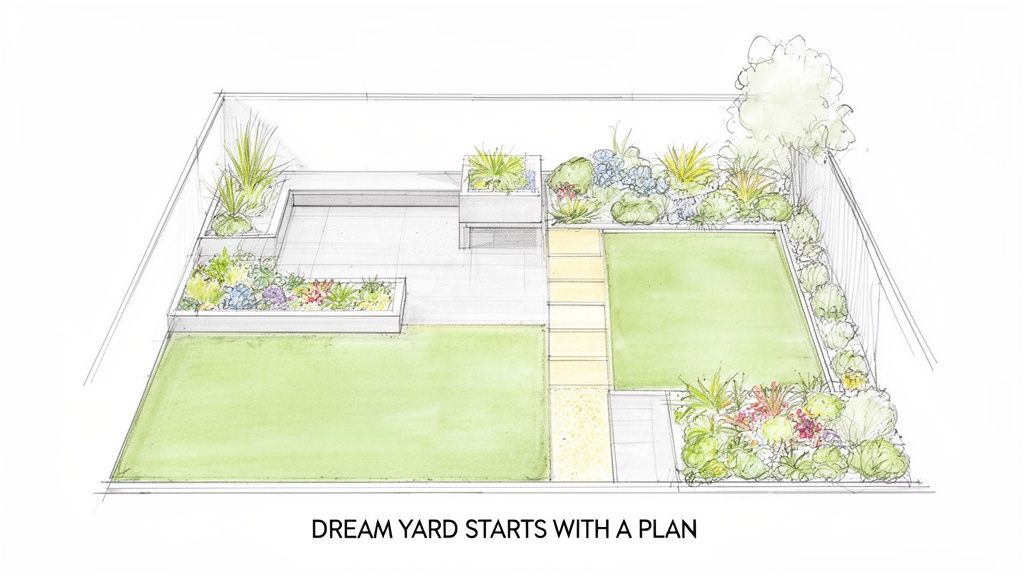
This approach lets you play around with different layouts, plant combinations, and hardscape styles without any commitment. It makes the whole process more fun and interactive. For a deeper dive into the principles, this practical guide to garden landscape design is a fantastic resource to have open in another tab.
Why Planning Matters Now More Than Ever
The desire for amazing outdoor living spaces has exploded. The global landscaping market is expected to balloon from $315.32 billion in 2024 to an incredible $528.59 billion by 2035. That's a massive signal of how much we've all come to value our yards as true extensions of our homes.
A great landscape plan does more than just arrange plants; it creates an extension of your home. It defines how you live, relax, and connect with nature right outside your door.
With apps like DreamzAR, you can apply AI Landscape Design to visualize your ideas using photos of your own yard and start generating concepts in minutes. This is a game-changer for refining your vision and communicating it clearly, whether you're a hardcore DIYer or hiring a pro. If you need a spark of creativity, check out our guide on 10 outdoor living space ideas to transform your yard in 2025. This planning stage is your first real step toward creating a landscape you'll love for years.
Get to Know Your Yard and Set Your Goals
Every truly great landscape design starts long before you pick up a shovel. It begins with a notepad, a keen eye, and a little bit of detective work in your own backyard. Before you can map out your dream yard, you have to get intimate with the canvas you're working with—your property, exactly as it is right now.
Taking the time to really observe and document your yard's quirks and personality will save you from a world of expensive headaches down the road. It’s what ensures that gorgeous patio you’re dreaming of won’t become a swimming pool every time it rains, and the vibrant flowers you plant won't shrivel up in a patch of unexpected afternoon shade. This first step is all about making sure your dreams and your yard's reality are on the same page.
A Practical Guide to Site Analysis
Think of your yard as a living, breathing space with its own set of rules. Your first job is to learn them. A good site analysis doesn't need to be some complicated, technical ordeal. It's really just about gathering the essential clues that will guide every single decision you make from here on out.
Start simple: create a base map. You can sketch it by hand on graph paper or use an online tool, but the goal is to get a bird's-eye view of your property. Make sure you include the footprint of your house, any existing driveways or paths, big trees you want to keep, and any other permanent fixtures. This map is about to become your design headquarters.
Mapping Your Yard's Unique Conditions
With a basic outline in hand, it's time to start layering on the juicy details. This is the information that will help you create a landscape plan that doesn't just look good, but actually works.
Key Observations to Make:
Sun and Shade Patterns: This is probably the #1 factor for choosing the right plants. Spend a full day just watching your yard. Where does the sun hit in the morning, at noon, and in the late afternoon? Mark these spots on your map. An area that gets blasted by the morning sun might be in deep shade by 3 p.m., which completely changes what you can plant there.
Soil Conditions: You don't need a degree in soil science, but a basic understanding is critical. Is your soil sandy and quick-draining, or is it a heavy clay that holds onto every drop of water? A simple "jar test" can give you a pretty good idea. For a more detailed analysis, grab a soil testing kit from your local extension office. Knowing how to read soil test results will be your secret weapon for choosing the right plants and soil amendments.
Topography and Drainage: Take a walk around after the next rainstorm. Note any slopes, low spots, or areas where water seems to hang out. These features can be challenges, sure, but they can also be amazing opportunities for cool solutions like a rain garden or terraced beds.
Measurements and Scale: Good old-fashioned measurements are a must. You'll need to know the dimensions of your property lines, the distances between existing features, and the overall square footage you have to play with. For a detailed walkthrough, check out our guide on how to measure a yard for your landscape project.
From Analysis to Aspiration: Your Wish List
Okay, now that you have a solid handle on your property's reality, the fun can really begin. It's time to define what you actually want from your outdoor space. This is where you translate your family's lifestyle into a functional, beautiful design.
A successful landscape isn't just a collection of pretty plants; it's a personalized environment designed to support and enhance your daily life. It’s the backdrop for family barbecues, quiet morning coffees, and kids' laughter.
To build out your wish list, start asking questions. Are you picturing a big, open space for entertaining, or a cozy little nook just for two? Is a safe, designated play area for kids a top priority? Maybe you're dreaming of a vegetable garden, a calming water feature, or a super low-maintenance design that frees up your weekends. Get it all down on paper—no idea is too big or too small at this stage.
The Magic of AI Visualization
This is the moment where your practical site analysis and your creative wish list finally meet. It can be incredibly hard to actually picture how a new fire pit area or a winding garden bed will look and feel in your actual yard. This is where you can apply AI Landscape Design to visualize your ideas using photos of your own yard, which completely changes the game.
Using an app like DreamzAR, you can snap a photo of your yard and start dropping in your ideas almost instantly. Want to see how a paver patio looks off the back door? Done. Curious about how different plant combinations would look along the fence? You can see it in seconds. This kind of tool takes your raw data—the photo of your space—and your wish list and spits out real, tangible design concepts. It’s an amazing way to test-drive your ideas, see what works, and get genuinely excited about the possibilities before you ever break ground.
Visualizing Your Ideas with AI Landscape Design
You’ve got a solid handle on your property's quirks and potentials. Now, it's time to connect that practical site analysis to your creative wish list. This is where your vision for a new yard really starts to feel real. Forget staring at a blank piece of paper—modern tech has turned brainstorming into an exciting, hands-on process.
Traditionally, this meant pulling out the pencils for rough sketches and clipping magazine photos for mood boards. While those are still useful, they often don't quite capture how a design will actually look and feel in your specific space. A great starting point is to map out different "zones" for dining, relaxing, or playing. A quick bubble diagram, where you just draw circles for each zone on your base map, is perfect for thinking about how everything flows together. You'll quickly see that the dining zone probably needs to be near the kitchen door, while a quiet reading nook might be better off tucked away in a shady corner.
Supercharge Your Brainstorming with AI
This is where the real fun begins. Instead of just guessing how a Japanese-inspired garden or a sleek, modern xeriscape might look in your backyard, you can actually see it. The trick is to apply AI Landscape Design to visualize your ideas using photos of your own yard, turning it into a digital canvas. It's a game-changer that removes the guesswork and opens up a world of possibilities you might not have considered on your own.
The process is refreshingly simple. With an app like DreamzAR, you start with a single photo of your yard as it is right now. From that one image, the AI can generate dozens of professional-quality design concepts in seconds. This isn't just about dropping in a few digital plants; it's about completely reimagining the space with different styles, materials, and layouts.
The simple flowchart below shows how the core steps of site analysis feed directly into this creative process, turning your initial data into actionable design inputs.
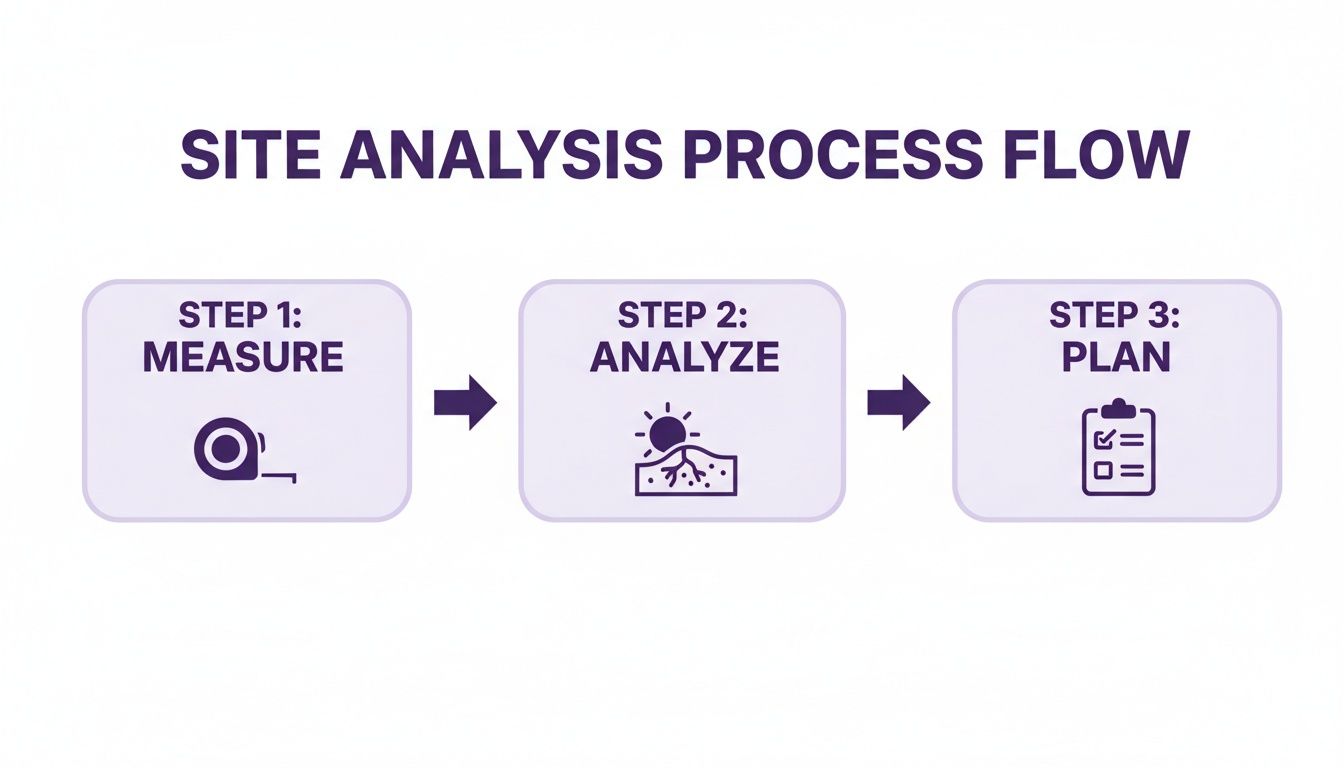
This straightforward flow—from measuring to planning—provides the foundational data that AI tools use to generate realistic and site-appropriate visuals for your landscape plan.
From a Simple Photo to a Powerful Vision
Imagine uploading a picture of your tired, patchy lawn and instantly seeing it transformed with a lush perennial garden, a chic paver patio with a fire pit, or a drought-tolerant rock garden. This is the power you get when you apply AI Landscape Design to visualize your ideas using photos of your own yard.
Here’s why it’s so effective:
Explore Diverse Styles: You can effortlessly test-drive aesthetics you're curious about but hesitant to commit to, from rustic cottage gardens to minimalist modern designs.
Rapid Iteration: Don't love the first concept? Generate another one. And another. You can cycle through countless ideas in the time it would take to make a single hand-drawn sketch.
Realistic Context: See how new elements will actually look against your house, your fence, and your existing trees. This gives you a level of realism that abstract plans just can't match.
AI-generated visuals become a powerful communication tool. They help you align your vision with your family's expectations and provide crystal-clear direction if you decide to share your landscape plan with a contractor.
This technology isn't just a novelty; it reflects a huge shift in how homeowners are approaching design. The landscape design industry in the U.S. has seen steady growth, with the market projected to hit $9.3 billion in 2025. This boom is fueled by homeowners investing more in their outdoor spaces, empowered by new tools that make professional-level design more accessible.
Making Your AI-Generated Concepts Actionable
The visuals you create are more than just pretty pictures; they're the foundation of your final landscape plan. Once you land on a concept (or a combination of ideas) you love, you can start breaking it down into a real plan.
Identify Key Elements: Look closely at the AI design. What do you love most? Is it the curved pathway, the type of pavers used, the mix of tall grasses and flowering shrubs, or the location of the seating area?
Create a "Shopping List": Start listing the specific plants and materials you see in the design. This visual gives you a concrete starting point for your research.
Refine Your Zones: The AI-generated layout can help you solidify the placement of your functional zones. You might realize the dining area looks much better on the west side of the yard to catch the evening sun.
This process turns abstract ideas into a tangible visual reference. It’s an incredibly effective way to validate your choices and build confidence before spending a single dollar on materials. For those ready to dive deeper into this technology, our ultimate guide to visualizing your yard with AI offers even more tips and techniques. This visualization step is easily the most empowering part of the process, turning your dream yard from a vague idea into a clear, achievable vision.
Choosing the Right Plants and Materials
Now that you have a solid visual direction from your brainstorming and AI concepts, it’s time to get specific. We're moving from the big picture to the individual building blocks of your landscape—the plants and hardscape materials that will bring your design to life. This is where art meets science; where the look you want has to line up with the reality of your environment.
Making smart choices here is a big deal for the long-term health and enjoyment of your yard. The right plant in the right spot will thrive without a fuss. The wrong one? It's a constant battle that costs you time, money, and frustration. It's the same with your patio material—picking the right one means it will look fantastic and stand up to the elements for years.
The 'Right Plant, Right Place' Philosophy
If there's one golden rule in landscape design, this is it. It's all about choosing plants that are naturally suited to your climate zone, sun patterns, and soil. I've learned the hard way that when you fight Mother Nature, you lose. But when you work with her, you end up with a garden that’s healthier, tougher, and a whole lot less work.
Before you even think about heading to the nursery, pull out that site analysis again. Your map of sun and shade patterns is now your most important tool. A spot getting 6+ hours of direct sun is considered "full sun," while an area with less than 4 hours is "full shade." Anything in between is "part sun" or "part shade."
Let these observations guide your plant list:
Climate Zone: First thing's first, know your USDA Plant Hardiness Zone. It tells you which plants have the genetics to survive winter in your neck of the woods.
Sun Exposure: Don't fall for a beautiful plant that needs full sun if you've only got a shady corner for it. Match plants labeled "full sun," "part shade," or "shade" to the right spots in your yard.
Soil Type: Pick plants that like what you've got, whether it's sandy, heavy clay, or rich loam. Yes, you can amend soil, but starting with plants that are already happy with the conditions is a massive shortcut to success.
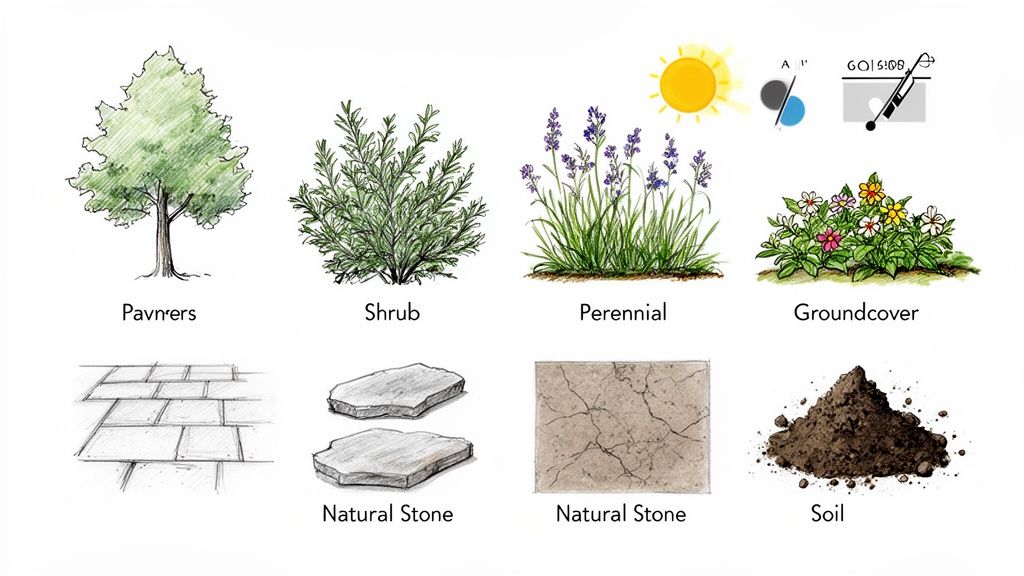
Creating Layers with Different Plant Types
A truly stunning landscape isn’t flat; it has depth and texture. You create this by layering different types of plants, with each category playing a specific role. Think of it like composing a piece of music, with high notes and low notes.
Trees: These are the "bones" of your landscape. They provide structure, create shade, and add that all-important vertical interest.
Shrubs: I use these to define different "rooms" in the garden, create privacy from neighbors, or just add a solid block of year-round color.
Perennials: These are the workhorses that come back every year, offering seasonal pops of color and texture.
Groundcovers: These low-growing plants are perfect for filling in gaps, keeping weeds down, and covering tricky slopes where mowing is a pain.
If you're in a drier climate, smart, water-wise plant choices are non-negotiable for a sustainable design. For some great ideas, check out our guide to the 10 best drought-tolerant plants for front yard landscapes in 2025.
Visualizing Your Choices with AI
It’s one thing to see a plant in a catalog, but it’s another thing entirely to know how that Japanese Maple will actually look next to your gray stone patio. This is where you can apply AI Landscape Design to visualize your ideas using photos of your own yard, making it an incredibly powerful tool once again, even at this nitty-gritty stage.
Your AI-generated visuals aren't just for the initial "wow" factor. They're dynamic tools for fine-tuning your material and plant palette. Use them to audition different combinations and see how textures and colors play off each other in your actual space.
With an app like DreamzAR, you can take a design concept you love and start swapping out the details. Just upload a photo of your yard, apply a design, and then play around. See what happens when you switch from dark mulch to light river rock, or from classic red brick to organic flagstone. This process gives you a surprisingly accurate preview of the final result and helps you avoid those expensive "I wish I'd gone with the other one" moments.
Selecting Hardscape Materials
Hardscaping—the non-plant elements like patios, walkways, and retaining walls—is the functional backbone of your outdoor space. The materials you choose will have a huge impact on the final look, but also on the durability, required maintenance, and, of course, the budget.
Here’s a look at some common materials.
Hardscape Material Comparison for Your Yard
Choosing the right hardscape material is a balancing act between aesthetics, budget, and long-term maintenance. This table breaks down the pros and cons of the most popular options to help you decide what's best for your project.
Material | Average Cost (per sq ft) | Durability/Lifespan | Maintenance Level | Best For |
|---|---|---|---|---|
Concrete Pavers | $8 - $25 | 50+ years | Low | Patios, walkways, driveways |
Natural Stone | $15 - $50+ | 100+ years | Low | Patios, walkways, high-end look |
Poured Concrete | $6 - $15 | 25-50 years | Low to Moderate | Modern patios, utility paths |
Brick | $10 - $30 | 100+ years | Moderate | Traditional walkways, borders |
Gravel/Decomposed Granite | $1 - $5 | Varies (needs refreshing) | Moderate | Informal paths, rustic patios |
No single material is perfect for every situation. Pavers offer incredible versatility, while natural stone provides a timeless, high-end feel that's hard to beat. Your final choice will come down to what fits your style, how you plan to use the space, and what your budget allows.
Alright, this is where the rubber meets the road. All that time you've spent analyzing your yard, playing with incredible AI-driven possibilities, and picking out the perfect plants and pavers is about to pay off. It’s time to pull all those threads together into an actionable roadmap: your final master plan and a budget that holds up in the real world.
Think of the master plan as more than just a sketch. It's a to-scale drawing that will become the definitive guide for your entire project. It’s what shows you the precise location of every tree, shrub, walkway, and patio stone, ensuring everything fits together just as you've envisioned.
Drafting Your To-Scale Master Plan
Your master plan is the official blueprint for your new yard. Start with that base map you made earlier—the one with your house, property lines, and anything you're keeping. From there, you'll transfer your final design onto it, paying close attention to scale. An easy way to do this is with graph paper, letting one square equal one square foot of your yard.
As you draw, label everything with detail. Don't just write "tree"; specify "Autumn Blaze Maple." Instead of "patio," note "Bluestone Pavers." The more specific you are—right down to lighting fixtures and irrigation heads—the smoother the actual installation will be.
Your master plan is the critical link between your vision and the physical work. It eliminates guesswork, helps you get accurate quotes from contractors, and gives you a clear path if you're going the DIY route.
This detailed plan becomes your single source of truth. It's what prevents those costly, split-second decisions and ensures every single element lands exactly where it will have the most impact.
Building a Realistic Landscape Budget
With your detailed plan in hand, you can finally build a budget you can trust. A solid financial plan is your best defense against surprise costs, helping you put your money where it matters most.
The best way to start is by breaking the project down into major cost categories. This makes the whole process feel much less intimidating and shows you exactly where every dollar is going.
Here’s how I typically break it down:
Hardscaping Materials: This is all your non-plant stuff—pavers, stone, gravel, edging, and materials for any walls or structures.
Plants and Soil: Tally up all your trees, shrubs, perennials, and groundcovers. Don’t forget to add in the cost of good topsoil, compost, and mulch.
Tools and Equipment: Are you renting a sod cutter or plate compactor for the weekend? Buying a new set of garden tools? Factor it in.
Labor Costs: If you’re hiring out any part of the job, get multiple quotes. Give each contractor your master plan to ensure you're comparing apples to apples.
Contingency Fund: This is non-negotiable. Always, always set aside an extra 10-15% of your total budget for the unexpected. Trust me, it’s a lifesaver.
Once you have your list, it's time for some legwork. Call local nurseries for plant prices and visit landscape supply yards to get quotes on your hardscape materials. This is what grounds your budget in reality.
Phasing Your Project for Affordability
Let's be honest: a full landscape overhaul can be a big investment. If your dream design feels just out of reach, don't scrap it. A smarter move is to phase the project over several seasons or even a couple of years—and your master plan is the perfect tool for this.
Look at your plan and identify the most critical pieces. Maybe the patio and a few key trees are your priority for Year 1. Next spring, you can tackle the perennial beds and install the landscape lighting. Phasing makes the project more manageable, both for your wallet and your weekend warrior energy levels. For more ideas on this, check out our guide on smart landscaping on a budget. It’s a great way to build the yard you've always wanted over time without breaking the bank.
Got Questions? Let's Talk Landscape Design
As you start turning your big ideas into an actual plan, you're bound to have some questions. It happens to everyone. Getting a handle on these common queries upfront can save you a ton of headaches and help you sidestep those rookie mistakes.
Think of this as the final pep talk before you start digging in. We'll cover the questions we hear all the time from homeowners just like you.
When Is the Best Time of Year to Start Planning?
It’s tempting to wait for that first warm spring day to start thinking about your yard, but that’s actually the busiest, most frantic time to get started. The real secret? Do your planning during the late fall and winter months.
This "off-season" is your golden window. With the garden dormant, you have a clear view of your space and plenty of time to work through the site analysis, sketch out ideas, and nail down your final plan without feeling rushed. When spring finally hits, you'll be ahead of the game, ready to get quotes from contractors or buy materials before the seasonal rush drives up prices and limits availability.
How Can I Design a Low-Maintenance Yard?
A gorgeous yard shouldn't feel like a second job. The trick to a low-maintenance landscape is all about making smart, intentional choices from the get-go. It's less about avoiding yard work entirely and more about creating a design that works with nature, not against it.
Here are a few strategies that really work:
Go Native: Choose plants that are native to your region. They’re already adapted to your local climate and soil, which means they'll thrive with way less water, fertilizer, and fuss once they're established.
Pick Durable Hardscaping: When you're planning patios or walkways, opt for materials built to last, like high-quality concrete pavers or natural stone. They cost more upfront but save you from the constant upkeep of cheaper options that need frequent sealing or replacement.
Rethink the Lawn: A smaller lawn instantly means less mowing, watering, and fertilizing. Consider replacing some of that endless sea of green with beautiful groundcover, mulched garden beds, or an expanded patio space.
A low-maintenance landscape is born from intentional design choices. By focusing on hardy plants and durable materials, you create a space that offers maximum enjoyment for minimal effort.
Can I Really Design a Plan Without a Professional?
Absolutely. While there's no substitute for the expertise of a seasoned landscape architect, today’s homeowners have more power than ever to create amazing, professional-quality plans on their own. Success really boils down to your willingness to do the research and how comfortable you are with the scale of your project.
If you're tackling something straightforward like a new flower bed or a simple patio, DIY is totally manageable. The real game-changer is how accessible modern design tools have become. This is the perfect place to apply AI Landscape Design to visualize your ideas using photos of your own yard.
Instead of squinting at a sketch and trying to imagine it in 3D, you can use an app to see what it actually looks like. Just upload a photo of your yard, and you can instantly cycle through dozens of styles, plant combos, and hardscape layouts. This kind of tech bridges the gap between your vision and a professional rendering, giving you the confidence to lock in a plan you know you'll love.
Ready to stop dreaming and start designing? With DreamzAR, you can turn a single photo of your yard into a stunning, professional-quality landscape design in seconds. Visualize your ideas, explore new styles, and create the outdoor space you’ve always wanted.