10 Actionable Ideas for Landscaping Front of House to Boost Curb Appeal in 2025
- Akhilesh Joshi
- 2 days ago
- 16 min read
Your front yard is more than just a patch of grass; it's the first impression your home makes and a direct reflection of your personal style. Crafting the perfect landscape can feel overwhelming, but it doesn't have to be. Whether you're aiming for a lush cottage garden, a sleek modern design, or a low-maintenance oasis, we've curated actionable ideas for landscaping front of house that will elevate your property's exterior.
This guide moves beyond generic advice to provide specific, practical concepts you can implement immediately. We’ll explore everything from hardscaping and foundation plantings to sustainable xeriscaping and formal garden designs. Beyond specific planting choices, exploring proven strategies to improve curb appeal and boost home value for your entire property can greatly inform your landscaping decisions, creating a cohesive and valuable first impression.
But how do you know which concept will truly suit your home's unique architecture? This is where technology offers a powerful advantage. Throughout this guide, we'll show you how to visualize each of these ideas on your own property using AI Landscape Design. With an app like DreamzAR, you can take a photo of your yard and instantly see these concepts come to life, allowing you to experiment with layouts, plants, and materials before breaking ground. Let's explore the possibilities and find the perfect design to frame your home.
1. Curb Appeal Enhancement with Foundation Plantings
Foundation plantings are the cornerstone of many front-of-house landscaping ideas, serving to anchor your home to its surroundings. This classic approach involves strategically placing shrubs, perennials, and small trees along the base of the house to soften harsh architectural lines and create a seamless transition from structure to lawn.
This technique is essential for hiding unsightly foundations, framing your entryway, and adding year-round visual interest. For instance, a colonial-style home benefits from structured boxwoods and elegant hydrangeas, while a modern facade is complemented by the clean lines of ornamental grasses and sculptural evergreen shrubs. You can use AI Landscape Design to upload a photo of your house and experiment with different plant combinations and layouts, allowing you to visualize the final result before committing and ensuring your foundation plantings perfectly enhance your home's curb appeal.
Key Implementation Tips
Layering for Depth: Place taller plants like Sky Pencil Holly or dwarf conifers in the back, medium-sized shrubs such as azaleas or spirea in the middle, and low-growing perennials or groundcovers in the front.
Strategic Spacing: Leave at least two to three feet between plants and your house wall to ensure proper air circulation and prevent moisture issues.
Right Plant, Right Place: Choose plants whose mature height will stay below your windowsills to avoid blocking natural light and views.
Year-Round Appeal: Mix evergreen species for winter structure with deciduous shrubs and perennials that provide seasonal color and texture.
Expert Insight: Group plants in odd numbers (threes, fives, or sevens) to create a more natural and visually balanced composition. This simple design trick prevents the arrangement from looking too symmetrical or rigid.
Not sure how these plantings will look against your home? Using an AI landscape design tool, you can upload a photo of your house and experiment with different plant combinations and layouts. This allows you to visualize the final result before committing, ensuring your foundation plantings perfectly enhance your home's curb appeal. Learn more about boosting your home's curb appeal with strategic landscaping.
2. Hardscaping Features and Stone Pathways
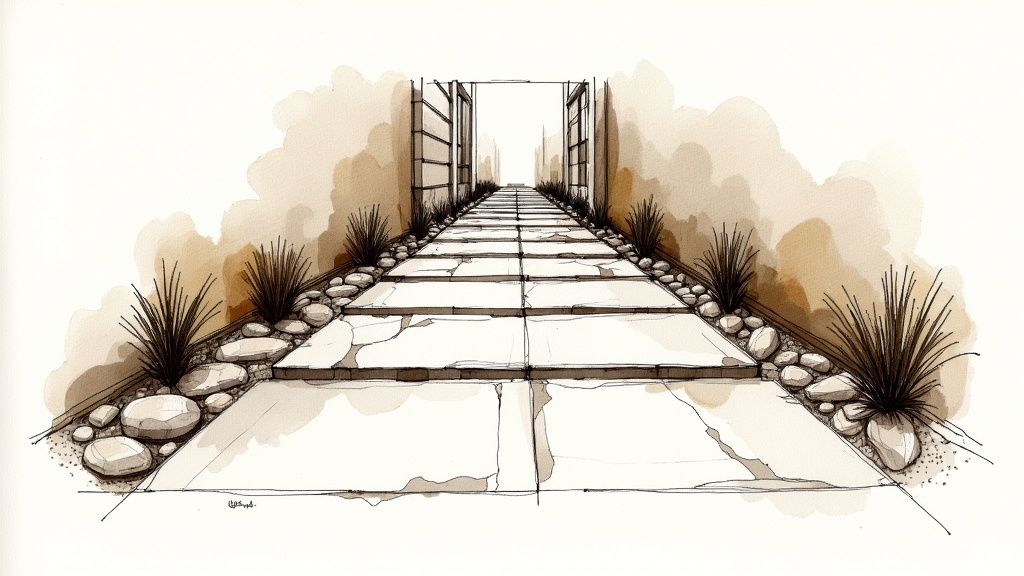
Hardscaping introduces non-living elements like stone, pavers, and gravel into your landscape to create structure and define spaces. A well-designed stone pathway is a classic hardscaping feature that guides visitors to your entrance while adding significant architectural appeal and texture. This approach provides a durable, low-maintenance foundation for your front yard design.
This technique is invaluable for creating clear, functional walkways, reducing lawn maintenance, and adding a touch of elegance. For example, a rustic flagstone path complements a Mediterranean-style home beautifully, while sleek bluestone pavers are perfect for a traditional New England property. Modern homes can benefit from geometric concrete pavers interspersed with decorative gravel.
Key Implementation Tips
Ensure Proper Drainage: Build a slight slope (about 1/8 inch per foot) away from your home to prevent water from pooling near the foundation.
Prevent Weed Growth: Use polymeric sand to fill the joints between pavers. This material hardens to lock stones in place and deter weed growth.
Maintain Comfortable Width: Design pathways to be at least three to four feet wide to allow for comfortable walking, even for two people side-by-side.
Match Your Home's Style: Select materials that complement your home’s architectural style and color palette to create a cohesive look.
Expert Insight: Incorporate low-voltage path lighting along your walkway. This not only enhances safety for evening guests but also creates a warm, welcoming ambiance and highlights the texture of your stonework after dark.
Visualizing how different paver materials or path layouts will look can be challenging. An AI landscape design app allows you to upload a photo of your front yard and digitally place various stone pathways and hardscape features. This helps you experiment with styles and find the perfect match for your home before any physical work begins. Learn more about designing paved driveways and walkways.
3. Low-Maintenance Native Plant Landscapes
Native plant landscaping is a sustainable approach that utilizes plants indigenous to your specific region. These plants are naturally adapted to the local climate, soil, and rainfall, meaning they require significantly less water, fertilizer, and pesticides once established. This creates a beautiful, self-sufficient landscape that works in harmony with the environment.
This technique is one of the best ideas for landscaping the front of your house if you prioritize low maintenance and ecological benefits. For example, a Texas front yard can thrive with vibrant Texas sage and hardy lantana, while a Northeastern property might feature drifts of coneflowers and black-eyed Susans that support local pollinators. These landscapes offer unique, regional beauty that traditional turf grass cannot match. With AI Landscape Design, you can upload a photo of your yard to visualize how these resilient native plants will look and complement your home's exterior before you start digging.
Key Implementation Tips
Research Local Species: Use resources from local native plant societies or university extensions to identify plants that are native to your specific hardiness zone and microclimate.
Group by Needs: Arrange plants with similar water and sunlight requirements together. This practice, known as hydrozoning, makes irrigation more efficient.
Proper Planting Time: In most regions, planting in the fall allows root systems to establish over the winter, giving plants a strong start for the spring growing season.
Embrace Natural Mulch: Allow fallen leaves to remain under your plants. This acts as a natural mulch, retaining moisture, suppressing weeds, and providing habitat for beneficial insects.
Expert Insight: Start small by converting a single section of your lawn or an existing garden bed to native plants. This makes the transition manageable and allows you to observe how the plants perform before expanding your native landscape.
Curious how a native garden would look in your front yard? With an AI landscape design app, you can upload a photo and experiment with different native plant combinations, from California poppies to New England asters. This helps you visualize how these resilient plants will complement your home's exterior before you start digging. Learn more about incorporating native plants into your garden design.
4. Welcoming Front Door Focal Points
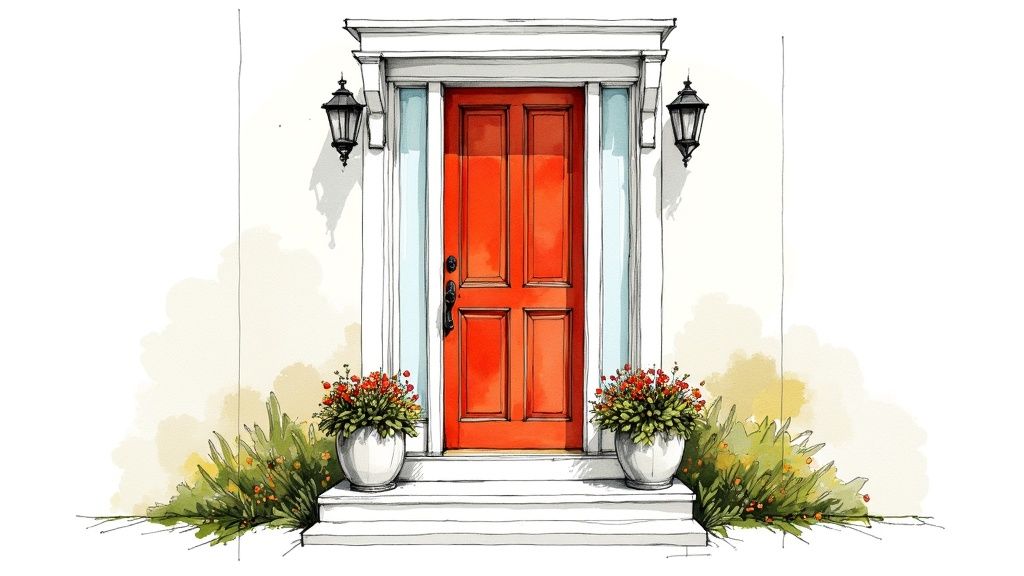
Creating a focal point around your front door is one of brisket. This strategy uses container gardens, architectural details, and intentional plant choices to frame the entrance, making it a clear and beautiful destination for visitors.
This approach is perfect for highlighting your home's main entry point and adding a personal touch that can be easily updated with the seasons. For example, a pair of elegant, potted topiaries can flank a traditional doorway to create symmetry and formality, while a modern entrance might feature a single, bold planter with a striking sculptural plant like a snake plant or a yucca.
Key Implementation Tips
Architectural Harmony: Select planters and containers whose style, material, and color complement your home's architecture. A terracotta pot suits a Mediterranean style, while a sleek metal planter fits a contemporary design.
Proportional Planting: Choose plants that are two to three times the height of their container to achieve a balanced and visually pleasing scale.
Seasonal Refresh: Swap out annuals in your containers seasonally. Use pansies in the spring, petunias in the summer, mums in the fall, and evergreen boughs in the winter for continuous appeal.
Strategic Color: Use your front door color as a guide for plant selection. Choose complementary colors (e.g., yellow flowers against a blue door) or analogous colors (e.g., red and orange flowers against a red door) to create a cohesive look.
Expert Insight: When arranging multiple containers, think beyond perfect symmetry. An asymmetrical grouping of three or five pots of varying sizes can create a more dynamic and professionally designed vignette next to your entryway.
Wondering which container style or plant arrangement will best suit your entrance? Use an AI landscape design tool to upload a photo of your front door and virtually place different pots and plants. This allows you to experiment with colors, sizes, and layouts to create the perfect welcoming statement before you buy anything. Learn more about boosting your home's curb appeal with strategic landscaping.
5. Sustainable Xeriscaping Design
Xeriscaping is a water-conserving landscaping method that emphasizes drought-tolerant plants, efficient irrigation, and reduced turf areas. This sustainable approach is ideal for regions with water restrictions, creating stunning landscapes while significantly reducing your environmental footprint and utility bills.
This technique is essential for homeowners looking to create a beautiful, resilient front yard that thrives with minimal water. For instance, a Southwest-style home is perfectly complemented by a mix of agave, cacti, and decorative rock gardens, while a California property can feature flowing ornamental grasses and vibrant succulents. To fully understand this water-wise approach, learn more about what is xeriscaping landscaping and how it can benefit your home.
Key Implementation Tips
Efficient Irrigation: Install a drip irrigation system on a timer to deliver water directly to the plant roots, minimizing evaporation.
Smart Mulching: Apply a three to four-inch layer of organic mulch like wood chips or bark to retain soil moisture and suppress weeds.
Strategic Grouping: Group plants together based on their water needs (hydrozoning) to make watering more efficient and effective.
Limit Lawn Areas: Reduce the size of your lawn, replacing it with hardscapes, groundcovers, or native plant beds.
Expert Insight: Select plants with silver or gray foliage, such as Lamb's Ear or Russian Sage. This coloration often indicates a plant has natural adaptations to reflect intense sunlight and conserve water, making them excellent choices for a low-water garden.
Wondering if a xeriscape design is right for your front yard? Use an AI landscape design tool to upload a photo of your house and experiment with various drought-tolerant plants, rock features, and gravel pathways. This helps you visualize how these sustainable ideas for landscaping the front of your house will look before you start digging. Learn more about how to create a drought-resistant landscape design.
6. Symmetrical Formal Garden Design
A symmetrical formal garden design emphasizes balance and order, creating a sophisticated and elegant landscape. This classic approach uses geometric shapes, structured plantings, and meticulously maintained lines to produce a powerful sense of harmony, making it one of the most timeless ideas for landscaping the front of a house.
This style is particularly effective for complementing traditional, colonial, or neoclassical architecture. It establishes a clear visual hierarchy with a central axis, often leading from the front door, with identical plantings mirrored on either side. The result is a refined and stately appearance that conveys intention and grace.
Key Implementation Tips
Establish a Central Axis: Use your front door or a central walkway as the main axis and ensure all design elements are mirrored perfectly on both sides.
Geometric Precision: Incorporate geometric shapes like squares, rectangles, and circles in your beds and pathways. Use clipped boxwood hedges to define these shapes clearly.
Symmetrical Plant Selection: Use matching plants in identical arrangements on each side of the axis. Paired topiaries, urns, or specimen trees are excellent for flanking an entryway.
Maintain with Pruning: Regular and precise pruning is essential to maintain the clean lines and defined shapes that characterize formal design. Slow-growing plants like Boxwood or Yew are ideal.
Expert Insight: For a truly formal effect, create a limited color palette. Rely on varying shades of green foliage and textures, using white or single-color flowers as elegant accents rather than a riot of mixed colors.
Unsure if such a structured layout suits your home's facade? An AI landscape design app allows you to upload a photo and create a perfectly symmetrical mock-up. You can test different geometric patterns and plant pairings to ensure the formal design achieves the desired balance and elegance before you start planting. Learn more about boosting your home's curb appeal with strategic landscaping.
7. Modern Minimalist Landscaping
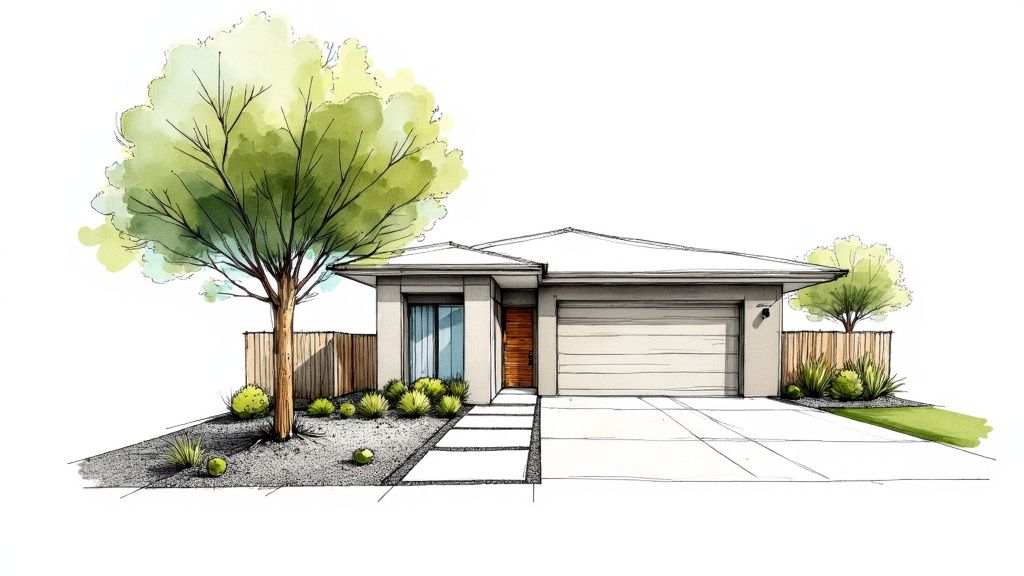
Modern minimalist landscaping is one of the most sophisticated ideas for landscaping the front of a house, emphasizing simplicity, clean lines, and purposeful design. This "less is more" approach uses a limited palette of plants and materials to create a bold, uncluttered statement that complements contemporary architecture.
The core principle is to make every element count. Instead of dense plantings, you might see a single, sculptural Japanese Maple set against a backdrop of dark gravel, or linear beds of ornamental grasses lining a sleek concrete walkway. The goal is to create a serene, organized, and low-maintenance space where structure and form take center stage.
Key Implementation Tips
Limited Plant Palette: Stick to three to five plant varieties with strong architectural forms, like Snake Plant, Horsetail Reed, or Blue Fescue grass.
Incorporate Negative Space: Use gravel, smooth stones, or a simple lawn as "empty" space to make feature plants stand out more dramatically.
Geometric Hardscaping: Integrate clean, geometric shapes through concrete pavers, steel edging, or rectangular planter boxes.
Strategic Repetition: Repeat plant varieties or hardscape elements in a rhythmic pattern to create a sense of cohesion and order.
Expert Insight: Focus on texture and form over color. A minimalist design thrives on the contrast between the soft texture of ornamental grasses, the smooth surface of concrete, and the rough texture of gravel.
Visualizing how negative space and bold plant forms will interact with your home's facade can be challenging. An AI landscape design app allows you to upload a photo of your property and experiment with different minimalist layouts, helping you perfect the placement of each element for maximum impact. Learn more about boosting your home's curb appeal with strategic landscaping.
8. Colorful Annual and Perennial Flower Beds
Creating vibrant flower beds with a mix of annuals and perennials is one of the most effective ideas for landscaping the front of your house. This strategy provides dynamic, multi-season interest, ensuring your landscape is never dull. Perennials form the garden's backbone, returning each year, while annuals offer the flexibility to introduce new colors and textures seasonally.
This approach is perfect for homeowners who enjoy gardening and want a continuously evolving display. A classic cottage garden might mix bee balm and coneflowers (perennials) with cosmos and zinnias (annuals), while a more formal design could use perennial boxwood hedges to frame beds of vibrant annual impatiens or begonias. The combination ensures structure and spontaneous bursts of color.
Key Implementation Tips
Establish a Framework: Plant your perennials first to create the bed's structure, considering their mature size and bloom times for a layered effect.
Add Seasonal Punch: Fill in the gaps with annuals to provide instant, high-impact color that lasts from spring until the first frost.
Plan for Succession: Choose perennials and annuals with staggered bloom times to ensure there is always something flowering in your garden.
Maintenance is Key: Regularly deadhead spent blooms to encourage new growth and apply a layer of mulch to retain moisture and suppress weeds.
Expert Insight: Group plants with similar light and water requirements together. This "zoning" makes watering and care far more efficient and helps all your plants thrive equally.
Wondering which color combinations will best suit your home's exterior? Use an AI landscape design app to upload a photo of your front yard. You can then virtually place different flower beds, experimenting with annual and perennial mixes to see which design delivers the most stunning visual impact before you start digging.
9. Evergreen Privacy Screens and Windbreaks
Creating a living fence with evergreens is one of the most functional ideas for landscaping the front of a house. This approach uses strategically placed evergreen trees and shrubs to form a natural privacy screen or windbreak that defines property lines, blocks unwanted views, reduces noise, and protects your home from harsh winds.
This technique is essential for adding year-round seclusion and structure to your property. For example, a dense hedge of Emerald Green Arborvitae can create an elegant, formal boundary for a suburban home, while a staggered row of Colorado Blue Spruce can serve as a robust windbreak for a property in a northern climate, enhancing comfort and potentially reducing heating costs.
Key Implementation Tips
Stagger for Density: Plant trees in two offset, staggered rows rather than a single straight line. This creates a much denser, more effective screen for both privacy and wind reduction.
Proper Spacing is Crucial: To encourage faster growth and closure, space plants at approximately 50% of their mature width. This prevents overcrowding later on.
Select for Your Climate: Choose hardy, disease-resistant varieties suited to your region. Leyland Cypress is a fast-growing option for southern properties, but can be prone to issues in other zones.
Plan for Establishment: Ensure your new evergreens receive adequate and consistent water for the first one to two years to develop a strong root system.
Expert Insight: When planting a windbreak, the most effective placement is perpendicular to the direction of the prevailing winter winds. A well-designed windbreak can reduce wind speeds on its leeward side for a distance of up to 10 times the height of the trees.
Wondering how a row of arborvitae or spruce will look along your property line? Using an AI landscape design tool, you can upload a photo of your front yard and digitally place different evergreen species. This helps you visualize the scale, density, and final appearance of your privacy screen before you start planting. Learn more about boosting your home's curb appeal with strategic landscaping.
10. Low-Growing Ground Covers and Ornamental Grasses
Replacing traditional turf with low-growing ground covers and ornamental grasses is a modern approach to front-of-house landscaping that combines beauty with sustainability. This idea focuses on creating a textured, multi-layered carpet of plants that reduces lawn maintenance, suppresses weeds, and adds dynamic visual interest throughout the seasons.
This technique is perfect for homeowners looking to minimize mowing, conserve water, and introduce naturalistic elements inspired by designers like Piet Oudolf. For example, a sun-drenched slope can be transformed with drifts of feathery feather reed grass and colorful sedum, while shady areas under trees can become a lush tapestry of moss or spreading wildflowers.
Key Implementation Tips
Layer for Visual Effect: Combine the soft, fine textures of grasses like blue fescue with the broad leaves of ground covers such as creeping juniper to create contrast and depth.
Plant for Coverage: Space ground cover plants densely, typically 12 to 18 inches apart, to encourage quick coverage that will effectively choke out weeds.
Seasonal Maintenance: Cut back ornamental grasses in late winter or early spring to make way for new growth. Deadhead spreading perennials to encourage fuller, healthier expansion.
Match Plants to Conditions: Group species with similar sun, soil, and water requirements together to ensure the entire planting thrives with minimal intervention.
Expert Insight: In the first year, apply a thick layer of mulch between new plants. This conserves moisture, prevents weeds from taking hold, and gives the ground cover a chance to establish a dense, root-filled mat.
Visualizing how different textures and heights will look together can be challenging. An AI landscape design app allows you to upload a photo of your yard and experiment with various ground cover and grass combinations. This helps you perfect the layout and ensure the final design achieves the low-maintenance, high-impact look you desire. Learn more about laying ground covers for a stunning landscape.
10-Option Front Yard Landscaping Comparison
Design Option | Implementation Complexity 🔄 | Resource Requirements ⚡ | Expected Outcomes 📊 | Ideal Use Cases 💡 | Key Advantages ⭐ |
|---|---|---|---|---|---|
Curb Appeal Enhancement with Foundation Plantings | Medium — planning layered beds and pruning routines | Moderate — shrubs, perennials, soil/mulch; ongoing maintenance | Immediate aesthetic boost; +5–10% property value; seasonal interest | Traditional and cottage homes, framing entrances | Softens architecture, year-round color, privacy |
Hardscaping Features and Stone Pathways | High — grading, drainage and precise installation | High — stone/pavers, base materials, skilled labor | Durable, defines circulation, low regular upkeep (20+ years) | High-traffic entries, accessibility routes, formal approaches | Long-lasting structure, clear paths, low maintenance |
Low-Maintenance Native Plant Landscapes | Low–Medium — requires species knowledge and grouping | Low — reduced water/fertilizer; sourcing regionals | 50–80% water reduction; supports pollinators; lower long-term costs | Eco-focused yards, drought-prone regions, wildlife gardens | Sustainable, low-input, climate-adapted plantings |
Welcoming Front Door Focal Points | Low — container placement and color coordination | Low — pots, seasonal plants, occasional replacements | Instant curb appeal; flexible seasonal looks; budget-friendly | Small porches, renters, quick curb-appeal upgrades | High visual impact for low cost; easily changeable |
Sustainable Xeriscaping Design | Medium–High — thoughtful layout and irrigation design | Moderate — drought plants, drip systems, soil amendments | 50–80% water savings; lower utility bills; low ongoing maintenance | Arid climates, water-restricted areas, large dry slopes | Water conservation, long-term cost savings, resilient |
Symmetrical Formal Garden Design | High — precise symmetry, pruning and layout control | High — structured materials, ongoing skilled labor | Elegant, timeless appearance; high perceived property value | Colonial/traditional estates, formal entrances | Orderly, refined aesthetic; classic curb appeal |
Modern Minimalist Landscaping | Medium — precise design and limited palette | Low–Moderate — quality hardscape, few plant types | Sophisticated contemporary look; reduced maintenance when executed | Modern architecture, small yards, low-maintenance goals | Clean lines, easy long-term care, strong architectural fit |
Colorful Annual and Perennial Flower Beds | Medium — seasonal planning, deadheading and rotation | Moderate — annuals/perennials, regular watering and care | Continuous seasonal color; attracts pollinators; customizable | Cottage gardens, seasonal displays, pollinator plots | Vibrant year-round interest; highly customizable |
Evergreen Privacy Screens and Windbreaks | Medium — spacing and species selection for mature size | Moderate — trees/shrubs, space, time to establish | Year-round privacy; wind/noise reduction; energy benefits | Property boundaries, wind-exposed sites, privacy needs | Durable screening, microclimate improvement, long-term value |
Low-Growing Ground Covers and Ornamental Grasses | Low–Medium — initial establishment and spacing | Low — plants, mulch; occasional thinning | Reduces lawn maintenance; erosion control; textural contrast | Slopes, low-maintenance beds, between pavers | Weed suppression, erosion control, low upkeep |
Bring Your Vision to Life: Your Next Steps to a Stunning Front Yard
You have now explored a diverse range of ideas for landscaping front of house, from the structured elegance of formal gardens to the sustainable beauty of xeriscaping. We've covered foundational concepts like establishing strong focal points at your front door, building texture with hardscaping, and layering plants for year-round interest. The journey from a plain, uninspired yard to a vibrant, welcoming landscape is built on these very principles.
The key takeaway is that great front yard design is a thoughtful blend of personal style, environmental considerations, and architectural harmony. It's not just about planting flowers; it's about creating an intentional experience that begins the moment someone sees your home. Whether you opt for the low-maintenance appeal of native plants and ornamental grasses or the lush, colorful impact of perennial beds, your front yard is a powerful extension of your home’s identity.
From Inspiration to Implementation
The most significant challenge for many homeowners is bridging the gap between an idea and the final result. It's one thing to admire a minimalist modern design in a photo, but another to be confident it will complement your home's specific brick color, window placement, and roofline. This is where planning and visualization become your most critical tools.
Before you purchase a single plant or lay one paver, you must be able to see your vision in context. This crucial step prevents costly mistakes, saves countless hours of labor, and ensures the final outcome matches your expectations. Visualizing the scale of a stone pathway, the mature height of an evergreen screen, or the color combination of a flower bed against your home's facade is the secret to a successful project.
The Power of AI in Landscape Design
Traditionally, this visualization process required hiring expensive landscape architects or attempting to sketch designs by hand. Today, technology offers a far more accessible and powerful solution. AI landscape design tools empower you to become the architect of your own outdoor space, removing the guesswork entirely.
By using an application that can render design concepts directly onto a photo of your property, you can:
Test Different Styles: Instantly see how a formal, symmetrical design compares to a more natural, cottage-style garden.
Preview Materials: Experiment with various hardscaping materials, from flagstone pathways to modern concrete pavers, without any commitment.
Select Plant Palettes: Swap out different plant combinations to find the perfect mix of evergreen structure, perennial color, and ground cover texture.
This ability to iterate and refine your ideas for landscaping front of house in a virtual environment is a game-changer. It transforms a daunting project into an exciting creative process, giving you the confidence to move forward with a well-vetted plan that you know will enhance your home's curb appeal for years to come.
Ready to stop dreaming and start designing? Download the DreamzAR AI Landscape Design app to upload a photo of your front yard and instantly apply these landscaping ideas to see what works best for your home. Your perfect front yard is just a few taps away. DreamzAR AI Landscape Design