How to Plan a Garden Design From Scratch
- Akhilesh Joshi
- 2 days ago
- 20 min read

Planning a garden begins long before you ever pick up a shovel. It starts with a simple, honest look at your yard—understanding its quirks, its sunny spots, and its shady corners. From there, it's about dreaming: Do you see a rustic cottage escape or something more modern and clean? Nailing this foundation is what separates a garden that thrives from one that just… exists.
Starting Your Garden Plan The Right Way
Creating a garden is easily one of the most satisfying projects you can tackle at home. It’s your chance to craft a personal sanctuary, extend your living space into the fresh air, and really connect with nature. But the most breathtaking gardens aren't happy accidents; they’re the result of smart planning.
It's a universal desire. The global appetite for beautiful, functional outdoor spaces is exploding, with the landscape and garden design market expected to hit an incredible $230 billion by 2033. If you're curious about what's driving this trend, you can dig into the numbers in this comprehensive landscape design report.
Before you fall down a rabbit hole of perfect patios and flawless flower beds on Pinterest, let's take a step back. The first real move is to get to know your canvas—your yard—inside and out. This keeps your design grounded in what’s actually possible and sets you up for success.
Define Your Garden's Purpose and Style
First things first: what do you actually want your garden to do for you? The answer to this question is your north star, guiding every single choice you make from here on out.
Are you dreaming of a space for:
Relaxation? Maybe a quiet corner with a comfy bench, the gentle sound of water, and layers of calming green textures.
Entertaining? This could mean a spacious patio for outdoor dining, a fire pit for late-night chats, and enough room for friends to gather.
Growing your own food? Think functional raised beds for veggies, a fragrant herb garden right outside the kitchen door, or a few dwarf fruit trees.
Family fun? You'll need a tough lawn that can handle playtime, a dedicated spot for a playset, and maybe some fun, whimsical plantings to capture the imagination.
Once you know the what, you can think about the how. This is where style comes in. A sprawling, informal cottage garden packed with flowers gives off a totally different vibe than a sleek, modern design with sharp lines and carefully chosen plants.
To get a better handle on the basics, our guide on garden design basics for beginners is a great place to start.
Here's a quick look at a few popular styles to get your ideas flowing.
Quick Garden Style Comparison
This table breaks down some popular garden aesthetics to help you find the one that clicks with your home and your vision.
Style | Key Characteristics | Best For |
|---|---|---|
Cottage | Informal, dense plantings; mix of ornamental and edible plants; traditional materials like brick and stone. | Creating a charming, romantic, and relaxed atmosphere. |
Modern | Clean lines, geometric shapes; limited color palette; emphasis on hardscaping and structural plants. | Homes with contemporary architecture; creating a sleek, low-clutter outdoor room. |
Japanese Zen | Minimalist; use of rocks, gravel, water, and moss; carefully pruned plants; creates a sense of tranquility. | A peaceful, meditative space for contemplation and calm. |
Mediterranean | Drought-tolerant plants like lavender and olive trees; gravel and terracotta pots; warm, sun-baked feel. | Hot, dry climates; low-water and low-maintenance designs. |
Seeing these styles described is one thing, but picturing them in your own yard is another.
Visualize Your Future Garden with AI
This is often the hardest part—trying to imagine how a "Japanese-inspired zen garden with a small pond" would actually look in your backyard. It’s a huge leap of faith. Luckily, this is where technology can completely change the game. AI landscape design apps bridge that gap between your imagination and reality.
The process couldn't be simpler. You snap a photo of your own yard, upload it, and then type what you want to see. Curious about a "low-maintenance rock garden" by the front door? Or maybe a "private courtyard with a pergola"? By applying AI landscape design to a picture of your space, you can generate realistic visuals for you in seconds.
This is more than just a cool trick. The ability to see your ideas on your actual property takes all the guesswork out of the equation. You can play with different layouts, styles, and features using a photo of your own yard, making sure you’re totally in love with the plan before you start.
Creating Your Garden Blueprint
Alright, you've figured out why you want a garden and the general vibe you're going for. Now for the fun part: turning those daydreams into a concrete plan. Creating an accurate garden blueprint is probably the single most important step in this whole process. It's your foundation, ensuring every decision from here on out is based on the reality of your space, not just guesswork.
Think of it like an architect drafting a floor plan before a single wall goes up. You wouldn't just start building without knowing room dimensions, where the windows will go, or how the plumbing connects. Your garden deserves that same level of planning to make sure it's not just beautiful, but actually works for you.
This simple diagram breaks down the core process: analyze what you have, define what you want, and then choose your elements.
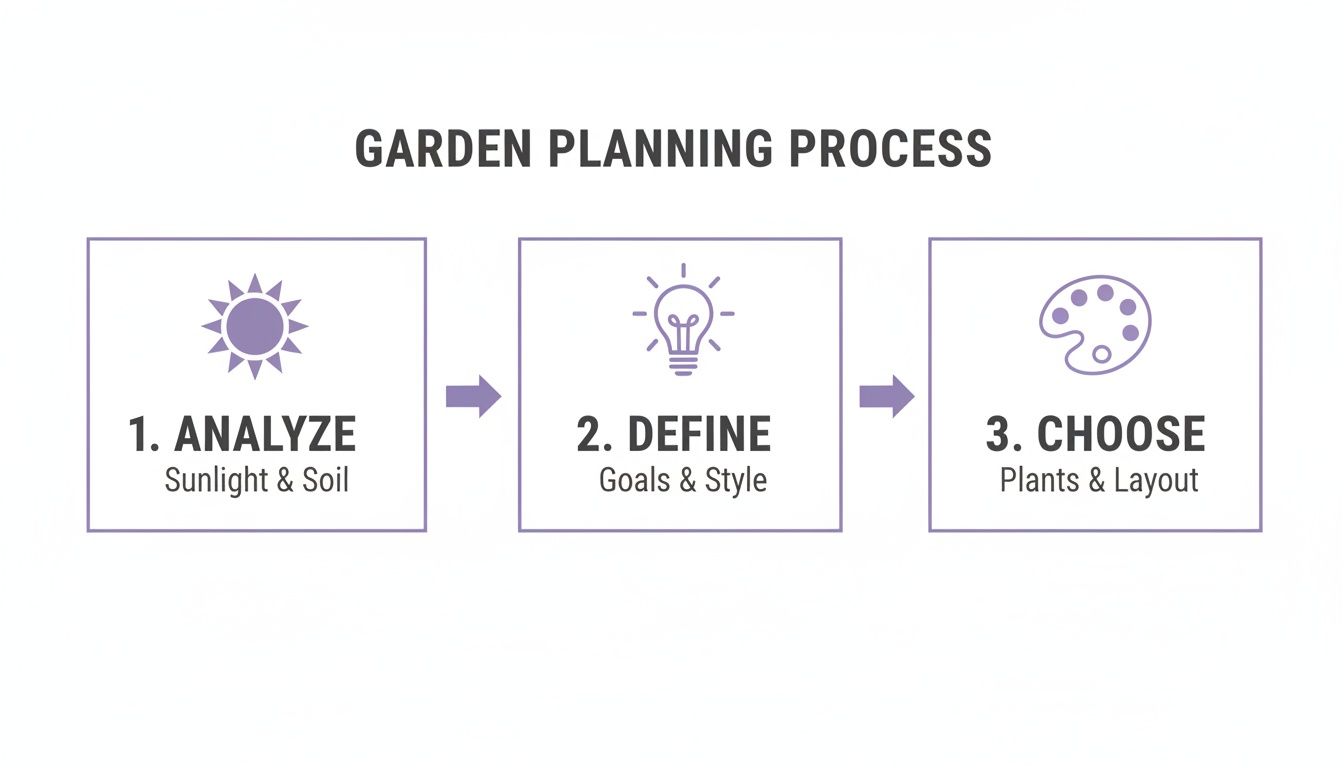
Stick to this sequence. It forces you to ground your design in reality before you fall in love with specific plants and materials that might not work.
Measuring and Mapping Your Space
First things first: you need precise measurements. Grab a long measuring tape, a notepad, and get ready to map out the entire project area. This isn't the time to eyeball it—accuracy now saves massive headaches later.
You’re basically creating a bird's-eye view of your yard. Be meticulous and mark the locations of:
Existing Structures: Your house, garage, shed, fences, and any existing patios or decks.
Key Landscape Features: Note the exact placement of mature trees you want to keep, big shrubs, or any significant slopes.
Utilities: Find your outdoor faucets, electrical outlets, septic tanks, and any known underground utility lines. This is a crucial safety step.
Windows and Doors: Mark where these are on your house. This is key for planning views from inside and making sure pathways make sense.
Getting these numbers right is non-negotiable. For a detailed walkthrough, check out our guide on how to measure a yard. Once you have everything, you can sketch your base plan to scale on graph paper, letting each square represent a foot or two.
Zoning Your Garden into Rooms
With your map in hand, it’s time to think like an interior designer and create distinct “rooms” or zones. This simple technique keeps your garden from feeling like one big, undefined blob. Instead, it creates a journey with different areas for different activities.
Think about how you actually want to use the space. You could create zones for things like:
An Entertainment Zone: A patio or deck for grilling and socializing.
A Relaxation Zone: A quiet corner with a bench or hammock tucked away.
A Utility Zone: A less visible spot for the compost bin, tool storage, or a small veggie patch.
A Play Zone: An open patch of lawn for kids or the dog to run around.
When you're mapping these areas, you might get some inspiration for designing a captivating patio to serve as the anchor for your social space. This approach ensures every square foot of your property has a clear purpose.
Visualize Your Blueprint with AI Design
This is where the magic really starts to happen. A flat, 2D blueprint is essential, but let's be honest—it can be tough to truly picture the final result. That’s where AI Landscape Design becomes an absolute game-changer. You can take your functional blueprint and bring it to life before you buy a single plant or paver.
It’s incredibly straightforward. Just upload a photo of your yard—the very space you just measured out. Then, using simple text prompts based on your zoned blueprint, you can tell the AI what you want to see. For instance, you could type: "Show a flagstone patio in the entertainment zone with a fire pit, and a small vegetable garden in the sunny utility zone."
By applying AI landscape design to a photo of your own yard, this process lets you immediately see how your zones connect, test out different materials, and play with plant arrangements. It transforms your abstract plan into a realistic, tangible vision, giving you the confidence to move forward and bring it to life.
See Your New Garden Come to Life with AI
Okay, you've got your base plan, your zones are mapped out, and you know what you want from your garden. This is where the real fun starts. It's time to take those sketches and ideas floating around in your head and turn them into something you can actually see.
Forget trying to imagine how a "Mediterranean courtyard with terracotta pots" will look against your specific brickwork. Modern tools have completely changed the game, letting you skip the guesswork and visualize the final result almost instantly.
The secret? AI landscape design. This isn't some far-off futuristic tech; it's here now, and it's surprisingly simple. You can take a quick photo of your plain, boring yard and see a rich, realistic preview of its full potential in seconds. It’s the best way to avoid costly mistakes and get excited about what's to come.
From a Simple Photo to a Stunning Reality
Honestly, the process couldn't be easier, and it’s built for homeowners, not tech wizards. Just grab your phone and take a clear, well-lit photo of the area you want to tackle. It could be the whole backyard, a sad-looking flowerbed by the front door, or that patch of dirt you pretend is a patio.
Next, you upload that photo to an AI design platform. This is your chance to play director. You guide the AI using simple text prompts—just short, descriptive phrases about what you envision.
For instance, you could upload a picture of your front yard and type in things like:
"A modern front yard with tall ornamental grasses, big river rocks, and a simple concrete path."
"A lush English cottage garden with a winding flagstone path and flower beds spilling over the edges."
"A low-maintenance desert vibe with succulents, light-colored gravel, and a dry river bed."
The AI takes your words and digitally paints your vision right onto your photo, giving you an immediate "after" shot. It's almost magical.
Here’s a perfect example of how an AI tool can take a basic yard and instantly mock up a fully realized design.

This kind of visual makes all the difference. You can suddenly see how mature plants fill the space, how hardscaping defines the zones, and whether the whole thing feels right. It gives you the confidence to move forward.
How to "Speak AI" for the Best Results
The designs the AI spits out are only as good as the instructions you give it. Vague prompts get vague results. The key is to be specific and descriptive. Put on your designer hat and think about the details: style, materials, key features, and even the mood.
Pro Tip: Don't hold back—experiment! The best part about using AI landscape design with a photo of your own yard is that you can generate dozens of variations without any risk. Try a Japanese Zen garden, then switch to a tropical paradise. Swap out a wood deck for a stone patio. This trial-and-error process costs nothing and is one of the fastest ways to figure out what you truly love.
Here are a few pointers for writing prompts that deliver:
Nail the Style: Instead of just "nice garden," try "Japanese-inspired zen garden" or "colorful pollinator-friendly garden."
Specify Materials: Get detailed. Say "deck made of dark composite wood" or "patio with irregular bluestone pavers."
Call Out Features: Want something specific? Ask for it. Prompt for "a small pond with a waterfall," "a cedar pergola over the seating area," or "raised cedar beds for vegetables."
Set the Mood: Use words that evoke a feeling, like "cozy and private," "open and sunny," or "secluded and shady."
This tech-driven approach to home improvement is exploding. The global home gardening market was valued at $15.78 billion in 2025 and is projected to hit $26.47 billion by 2034. People are serious about creating their own little green sanctuaries, and AI is making it easier than ever.
More Than Just a Pretty Picture
The really great AI landscape tools don't stop at static images. Some now incorporate augmented reality (AR), which is a total game-changer. You can hold up your phone and see the design overlaid onto your actual yard in real time.
Want to see if that fire pit will make the patio feel cramped? Just walk around it virtually. Curious how that new tree will cast shadows at 4 PM? AR can show you.
This immersive experience gives you an unmatched sense of scale and flow, ensuring the plan that looks amazing on screen will feel just as good in real life. It’s the final check you need before you grab a shovel and start digging. If you want to see more of what's possible, check out our other articles on AI landscape design.
Selecting Your Plants and Materials
With a clear plan in hand, you've arrived at what is, for many of us, the best part: choosing the plants and materials that will bring your garden to life. This isn't just about picking pretty flowers; it's about making smart, sustainable choices that will help your garden flourish for years to come.
This is where your vision starts becoming a reality. It's also where the real investment begins. To give you some perspective, the landscaping services market in the United States was valued at a staggering $331.05 billion in 2024. That number shows just how much we value creating outdoor spaces that are both beautiful and functional.
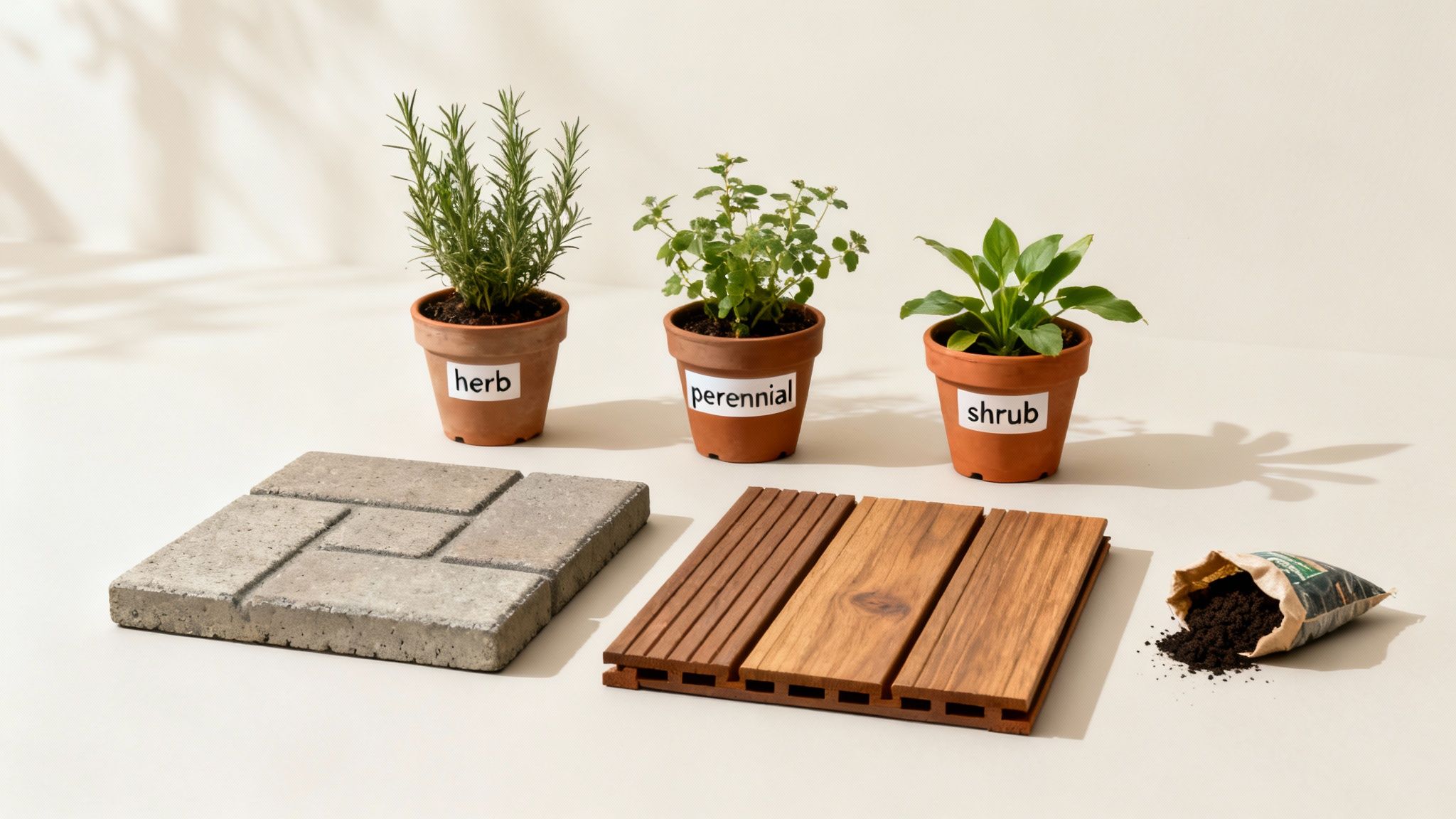
The Right Plant in the Right Place
If you only remember one rule of gardening, make it this one. A gorgeous, sun-loving plant will wither in a shady corner, no matter how much you fuss over it. Your site analysis from the beginning of this process is your most powerful tool here.
Use that knowledge to pick plants that are naturally suited to your yard's conditions:
Sunlight: Does this spot get 6+ hours of direct sun (full sun), or is it mostly in the shade?
Soil: Is your soil sandy and quick to dry out, or is it heavy clay that holds onto every drop of water?
Water Needs: Group plants with similar thirst levels together. This makes watering so much easier and more efficient. You don't want drought-tolerant lavender sitting next to a water-guzzling fern.
Following this simple principle saves you time, money, and a lot of frustration. Happy plants need less help from you and are far more resistant to pests and diseases, which means a healthier garden overall.
Layering for Year-Round Interest
A truly great garden has something to offer in every season, not just for a few glorious weeks in the spring. The secret to achieving this is layering. It's all about combining plants of different heights, textures, and bloom times to create a landscape that's always evolving.
Think of it like building a composition:
Start with the "Bones": These are your structural elements that look good all year. Think evergreen shrubs, ornamental trees, or even hardscaping like a trellis or a few well-placed boulders. They give the garden its shape, even in the dead of winter.
Add the Mid-Layer: Next come the perennial flowers and ornamental grasses. These fill in the gaps, bring waves of color through the seasons, and introduce all kinds of interesting textures.
Finish with Fillers: Finally, use annuals and bulbs for those big, seasonal splashes of color. They're perfect for plugging holes while your perennials get established and give you the freedom to switch up the look each year.
Visualizing Plants in Your Own Yard with AI
Trying to imagine how that tiny sapling at the nursery will look as a 20-foot tree next to your house is tough. This is where modern tools can completely change the game.
By applying AI landscape design to a photo of your own yard, you can digitally "plant" different trees, shrubs, and flowers. Snap a picture of your space and instantly see how a Japanese Maple’s deep red leaves will look against your brick, or test whether a line of boxwoods will actually give you the privacy you're hoping for. It takes the guesswork out of the equation.
This lets you experiment with different combinations and scales without any risk. If you need some ideas, you can explore extensive collections of plants, shrubs, and trees within the DreamzAR app to find new inspiration for your space before you even think about buying.
Demystifying Hardscaping Materials
Hardscaping covers all the non-living parts of your garden—the patios, pathways, walls, and decks. These elements are often the biggest-ticket items in a design, so choosing the right material is a huge decision.
Here's a quick rundown of common materials you might use for a patio or walkway:
Material | Pros | Cons | Best For |
|---|---|---|---|
Pavers | Incredibly durable, endless style options, and you can replace a single cracked one easily. | Installation can be a big job, and they might shift if the base isn't prepared correctly. | Super versatile for everything from modern patios to traditional driveways and paths. |
Natural Stone | Absolutely unique beauty, extremely tough and long-lasting. | It's heavy, very expensive, and getting a perfectly flat surface can be tricky. | Creating a high-end, timeless look for patios and garden walkways. |
Gravel | Very affordable, fantastic drainage, and a pretty straightforward DIY project. | It can get messy and kicked around. Not great for walking barefoot or for patio furniture. | Informal paths, low-traffic zones, and gardens with a rustic or Mediterranean vibe. |
Wood/Composite Decking | Gives a warm, inviting feel and is great for elevating a space off the ground. | Real wood needs regular maintenance. Composite costs more upfront but is very low-maintenance. | Building raised entertainment areas, especially if your yard has a slope. |
Your choice really comes down to balancing the look you want with your budget and how much maintenance you're willing to do. The materials you pick will set the tone for your garden for decades.
Budgeting and Phasing Your Project
Let’s be honest: a gorgeous garden plan is fantastic, but it’s just a dream until you figure out how to pay for it. This is where your grand vision gets real, meeting the practical world of spreadsheets and timelines. By tackling your budget and timeline head-on, you can make sure your dream garden doesn't morph into a financial nightmare.
Staring at the total cost can feel like a punch to the gut, but breaking it down makes it all manageable. Most of the money you'll spend on a garden project falls into a handful of buckets.
Hardscaping: This is usually the big one. We're talking about patios, decks, pathways, retaining walls, pergolas—anything solid. The price tag here is a mix of materials (think pavers vs. natural flagstone) and the labor to install it all.
Plants and Soil: This covers everything that grows, from a mature shade tree down to tiny perennial plugs. It also includes the lifeblood of the garden: quality soil amendments, compost, and mulch.
Professional Help: Are you going to need an electrician to run power for outdoor lighting? A landscaping crew to handle the heavy digging? Maybe a designer to sanity-check your plans? Those costs can sneak up on you.
Features and Furnishings: Don't blow the budget before you get to the good stuff! This is all the finishing touches—the comfy outdoor furniture, a fire pit, maybe a small water feature, planters, and decorative lights.
Making Your Budget Work Harder
A tight budget doesn't mean you have to scrap your vision. With some smart planning, you can make every dollar count. A classic money-saving tip is to buy smaller, younger plants. Sure, they might look a little sparse at first, but with a season or two of patience, they’ll fill in beautifully for a fraction of the cost of large, mature specimens.
Another pro move is to source your materials locally. You'll often find that local quarries or landscape supply yards have much better prices on things like stone, gravel, and mulch than the big-box home improvement stores. And be brutally honest about your own skills. Building a simple raised bed? Totally a great DIY project. Laying an intricate stone patio that needs to be perfectly level? That's probably a job for a pro. Knowing when to spend on labor and when to save with your own sweat equity is the secret.
The single most powerful tool for tackling a big project on a limited budget is phasing. You don’t have to build the entire garden in one go. Breaking it down into logical, bite-sized stages makes it so much more achievable, both financially and mentally.
How to Phase Your Garden Project
Phasing is simply the art of rolling out your master plan over time. It lets you start enjoying parts of your new garden way sooner while spreading the cost over a few years instead of one giant hit.
Here’s what a typical phasing plan might look like:
Year One: The Foundation. Get the biggest, messiest, most disruptive work out of the way first. This is the year you install the main patio or deck, run any underground utilities for irrigation or lighting, and plant the big "backbone" trees that need the most time to establish themselves.
Year Two: The Structure. With the hardscaping done, you can now build out the main planting beds. This means installing edging, bringing in and amending the soil, and planting the key shrubs and larger perennials that give the garden its shape.
Year Three: The Details. This is the fun part—the finishing touches. You'll fill in the gaps with smaller perennials, pop in some annuals for instant color, set up your container gardens, and finally bring in the furniture and decor that make it feel like home.
This staged approach is the cornerstone of a realistic garden plan. It transforms a massive, intimidating undertaking into a series of satisfying, achievable projects.
Bringing Your Garden Design to Life
Okay, you've got a solid plan, a clear vision, and a budget that feels right. It’s finally time to swap the graph paper for a shovel. This is the moment where all that careful preparation really starts to pay off as you begin physically shaping the outdoor space you’ve been dreaming of.
Making that jump from planner to doer is incredibly exciting. Having a clear, step-by-step game plan for implementation will make the whole process feel less like a chore and more like the rewarding experience it should be.
The first job, and you can’t skip this, is preparing your canvas. Before a single plant goes into the ground, you absolutely must clear the area of any weeds, old grass, or random debris. This initial ground-clearing gives your new plants a fighting chance, ensuring they won’t have to compete for nutrients and water from day one.
Once the slate is clean, it's all about the soil. Let's be honest, most residential soil needs a little help. It might be heavy clay that turns into a swamp after it rains or sandy soil that can’t hold onto moisture. Tipping in and working through several inches of high-quality compost isn't just a suggestion—it's the foundation for everything you hope to grow.
Executing Your Plan
With the site prepped, you can start laying out the bones of your design. Grab your blueprint and start marking out the exact locations for paths, patios, and planting beds. Simple tools like stakes and string or a can of landscape marking paint are perfect for getting your design off the paper and onto the ground.
This is where you get a real-world sense of scale and flow. It’s also your last chance to make small tweaks before anything becomes permanent. Maybe that pathway feels a bit tight now that you can walk it—go ahead and widen it by a few inches. Seeing it in your space is completely different from seeing it on a screen.
Key Takeaway: Always, always install your hardscaping first. Patios, walkways, and retaining walls are messy jobs. Get them done before you plant so you’re not trampling your new flowers and shrubs. It’s much easier to work when you have an open, clear site.
The Power of AR for Final Placement
Even with a perfect plan, it can be tough to visualize the final placement of big items. How much shade will that new ornamental tree really cast in the afternoon? Does the fire pit feel too close to the seating area? This is where technology can give you one last, powerful reality check.
Using an app with Augmented Reality (AR) lets you see your design elements right in your yard through your phone. You can digitally drop a full-sized 3D model of a tree or a pergola exactly where you plan to build it. Walk around it, see it from the kitchen window, and understand how it truly fits with your home.
This final visualization check erases any lingering doubt before you start digging. You can see a fantastic example of this in action by exploring how to bring your landscape design to life with the ultimate AR experience.
DIY vs. Hiring a Pro
Figuring out what to tackle yourself versus what to outsource is a huge decision. It comes down to an honest look at your skills, your available time, and just how complex the job is.
Great DIY Projects: Things like amending soil, planting perennials and shrubs, spreading mulch, and putting together simple raised beds are perfect for getting your hands dirty. They're rewarding and save a ton on labor costs.
Consider a Pro For: The technical stuff. Think complex stone patios, large retaining walls, or anything involving irrigation or electrical work. Hiring an experienced professional ensures the job is done right, built to last, and most importantly, safe.
Putting together a simple timeline—from soil prep to hardscaping to planting day—will keep your project on track and prevent you from feeling overwhelmed. This is it! The culmination of all your hard work is about to become a reality. With a methodical approach, you'll be kicking back and enjoying your new garden in no time.
Got Questions About Planning Your Garden?
Diving into a garden design project is thrilling, but let's be honest, it also brings up a ton of questions. I hear them all the time. From the nitty-gritty of costs to the creative hurdles of picking the right plants, getting some straight answers can make the whole adventure a lot smoother.
So, let's tackle some of the most common questions that pop up when you're figuring out how to plan a garden that you'll actually love. Getting these sorted will give you the confidence to move forward, sidestep common mistakes, and make sure the plan you end up with is beautiful, realistic, and completely you.
So, What's a Garden Design Actually Going to Cost Me?
This is the big one, isn't it? It’s usually the first thing people ask, and the most honest answer I can give is: it truly depends. You could be looking at a few hundred dollars for a simple DIY flower bed—soil, mulch, a flat of annuals. Or, you could be talking tens of thousands for a complete backyard overhaul with a new stone patio, a custom pergola, and a full professional planting.
The final number really boils down to a few key things:
Project Scale: A small front-yard refresh is obviously going to be a lot friendlier on the wallet than tearing out and redoing an entire acre.
Material Choices: There's a world of difference in cost between a simple gravel path and a patio laid with premium natural flagstone. The same goes for fencing, furniture, and everything in between.
Sweat Equity vs. Pro Help: Doing the work yourself is the single biggest way to save money. But for complex jobs like grading, electrical work, or masonry, hiring a pro is worth every penny to get it done right and safely.
Plant Size: This is a classic budget lever. Buying small, young plants is super cost-effective if you have patience. If you want that "instant impact" from mature trees and big shrubs, be prepared for a much higher price tag.
Here's a pro tip for managing the budget: Phase your project. Don't feel like you have to do it all at once. Tackle the hardscaping and big structural pieces in year one. Then, you can add planting beds and smaller features in the following years to spread out the cost.
How Can I Actually See My Ideas Before I Start Digging?
This is a huge mental block for so many people. It's one thing to have a sketch on paper, but it's another thing entirely to really feel what it will be like to stand in that space. It’s tough to translate a 2D drawing into a 3D reality in your head.
Thankfully, this is where technology has become a complete game-changer.
The absolute best way to see your ideas come to life is to use an AI Landscape Design app. I'm not just saying that; it fundamentally changes the process. Instead of starting with a blank slate, you start with a photo of your actual yard. You just upload a picture and tell the app what you want to see—things like "a modern stone patio with a fire pit and ornamental grasses."
In seconds, the AI generates a photorealistic image of that design right onto a photo of your own property. It completely removes the guesswork. You can:
Try on different styles—cottage, modern, zen—without any commitment.
Swap out materials for patios, decks, and walkways to see what looks best.
Visualize how different plant combinations and colors will look against your house.
Getting that visual confirmation is priceless. You know you'll love the final result before you spend a dime or lift a shovel, which makes the whole planning process feel much less risky and a lot more fun.
What Are the Biggest Mistakes I Should Avoid?
Even the most perfect-looking plan can go off the rails. Over the years, I've seen a few common missteps trip people up time and time again. Just knowing what they are can save you a world of headaches later on.
One of the most frequent mistakes is improper plant spacing. Everything looks so small and cute in its nursery pot, and it’s incredibly tempting to plant things close together for a full look right away. Don’t do it! Always design for the plant's mature size, or you'll have an overgrown, crowded jungle in a few short years.
Another classic error is ignoring your site's reality. It's easy to fall in love with a photo of a sun-drenched lavender field, but if you're trying to plant it in a shady, damp corner of your yard, you're just setting yourself up for disappointment. The old saying, "right plant, right place," is probably the most important rule in all of gardening. Work with your conditions, not against them.
Finally, be honest about maintenance. That stunningly complex English garden with intricate borders, a water feature, and dozens of delicate perennials? It’s gorgeous, but it's also a part-time job. Be realistic about how much time you truly want to spend weeding, pruning, and watering each week. Sometimes a simpler design with hardy native plants and durable hardscaping is the key to a garden you can actually enjoy.
Ready to stop guessing and start seeing? With DreamzAR AI Landscape Design, you can turn a photo of your yard into a stunning, professional-quality design in seconds. See exactly how that new patio, flower bed, or backyard oasis will look before you lift a single shovel. Your dream yard is just one photo away.