Cost to Install Paver Patio: Essential Guide to Pricing
- Akhilesh Joshi
- Jan 11
- 18 min read
So, you're dreaming of a new paver patio. Fantastic. But before you start picking out stone colors and patio furniture, there's that one big question looming: How much is this actually going to cost me?
Getting a handle on the numbers from the get-go is the key to setting a realistic budget and, more importantly, avoiding any nasty surprises down the road. The average cost to install a paver patio lands somewhere between $10 and $25 per square foot.
For a typical project, you could be looking at anywhere from $2,400 for a simple, straightforward design to well over $7,000 for a more intricate layout using high-end materials. Think of it like buying a car—the final price tag really depends on the model, features, and finishes you choose.
Your Paver Patio Cost: Answering The Big Question
The cost of a paver patio isn't a single, fixed number; it's a spectrum. A cozy 10x10 foot spot (that’s 100 sq ft) perfect for your morning coffee is going to sit on the lower end of that budget range. On the other hand, a sprawling 20x20 foot (400 sq ft) entertainment hub for summer barbecues will naturally command a higher price.
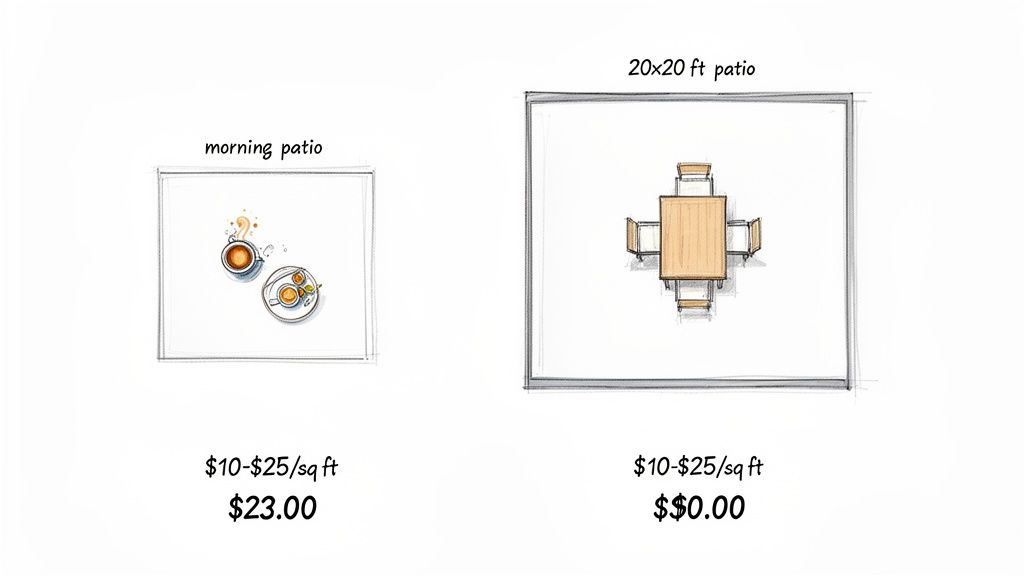
To give you a clearer picture, here’s a quick breakdown of what you might expect for common patio sizes.
Paver Patio Installation Cost At a Glance
This table breaks down the estimated total costs for different patio dimensions, helping you match your project size to a potential budget.
Patio Size | Budget-Friendly ($10/sq ft) | Mid-Range ($17/sq ft) | High-End ($25/sq ft) |
|---|---|---|---|
Small (10x10 / 100 sq ft) | $1,000 | $1,700 | $2,500 |
Medium (12x18 / 216 sq ft) | $2,160 | $3,672 | $5,400 |
Large (20x20 / 400 sq ft) | $4,000 | $6,800 | $10,000 |
Keep in mind these are ballpark figures. The final invoice will be shaped by your material choices, labor rates in your area, and any special features you decide to add.
Visualizing Your Project and Its Price
Before you lock in a budget, it’s a huge help to see how different sizes and designs will actually look in your yard. This is where modern tools can completely change the game.
You can use AI Landscape Design to visualize your ideas using photos of your own yard. With an app like DreamzAR, you just snap a photo of your yard and can instantly start playing around with different paver styles, colors, and patterns. It's a great way to:
Experiment with size: See for yourself how a 200 sq ft patio feels compared to a 400 sq ft one in your own space.
Compare materials visually: Can't decide between classic brick and modern concrete pavers? Now you can see both.
Refine your layout: Tweak the shape and borders to get the design just right before a single stone is laid.
This kind of technology bridges that tricky gap between your imagination and reality, making sure the final result is exactly what you were hoping for. You can even browse through a gallery of backyard landscape designs to get your creative juices flowing.
National Averages and Benchmarks
The numbers we're talking about are backed up by recent data. Across the U.S., a typical 280 sq ft patio costs around $3,350 to $3,800. That breaks down to about $12–$14 per sq ft for standard concrete pavers installed by a pro. This gives you a solid benchmark to start your financial planning.
To really dig into the details and plan your finances accurately, checking out a comprehensive tile cost calculator and budget guide can be incredibly helpful. With these foundational numbers, you’re now in a great position to start planning your perfect patio.
Visualize Your Budget With AI Landscape Design
Budgeting for a new patio can feel a bit abstract, like you're just moving numbers around on a spreadsheet. But what if you could actually see that patio in your own yard before you commit thousands of dollars?
This is where things get really interesting. Modern tech, especially AI landscape design, completely changes the planning game. It bridges that frustrating gap between what's in your head and what your budget can actually handle.
Forget trying to imagine how a tiny paver sample from a showroom will look across a whole 300-square-foot space. You can now bring your vision to life by applying AI Landscape Design to visualize your ideas using photos of your own yard.
See Your Patio Before a Single Stone Is Laid
AI-powered apps like DreamzAR let you skip the guesswork entirely. The process is surprisingly simple: snap a photo of your yard, and the app lets you overlay different paver designs, patterns, and materials right onto the image.
This isn't some generic mock-up; it's a personalized preview of your future patio in your actual space.
You can instantly:
Compare materials visually: Wondering about the warm, classic vibe of brick versus the clean lines of concrete pavers? Or maybe you want to see if natural stone is worth the splurge? Swap between them in seconds and see what truly complements your home.
Experiment with patterns: Test drive a simple running bond pattern against a more intricate herringbone. The visual impact can be huge, and seeing it first helps you choose with confidence.
Get the size right: Is a 200-square-foot patio big enough for your grill and a small table, or do you really need to bump it up to 350 square feet to entertain comfortably? Adjust the layout on the fly to find the perfect fit.
This visual confirmation is a huge deal. It helps you dodge the costly mistake of picking a material or design you end up hating. It ensures the finished product is exactly what you were hoping for. To see just how powerful this is, check out our deep dive into generative AI for patio design.
Here’s a look at how an AI tool can generate a full landscape concept, paver patio and all, right in your yard.
This kind of visualization lets you see how all the pieces—pavers, plants, furniture—will come together before you even think about breaking ground.
Connect Your Vision Directly to Your Budget
Here’s the most powerful part: using AI this way connects your design choices directly to your budget in real time. The cost to install a paver patio isn’t a static number; it changes with every decision you make. This technology makes that connection crystal clear.
As you tweak your design in an app like DreamzAR—maybe switching from budget-friendly concrete pavers to high-end travertine or adding another 50 square feet to the patio’s footprint—you can watch the cost estimate update right there on your screen.
This turns abstract numbers into a practical, interactive planning tool. Suddenly, you can make informed trade-offs. You might discover that making the patio just a little smaller lets you afford those premium pavers you’ve been eyeing. Or maybe you realize a simpler pattern cuts down labor costs enough to free up cash for that fire pit you wanted.
By seeing the financial ripple effect of each choice instantly, you can fine-tune your project to hit that sweet spot between your dream design and your real-world budget. No more surprise costs, just a smart, well-spent investment.
Decoding The Price Per Square Foot
The cost per square foot is the building block of your entire patio budget. But what makes that number jump from a wallet-friendly $8 all the way up to $50? It's never just one thing. It’s a bit like buying flooring for your house—a simple laminate is worlds away from imported marble, and the same idea applies to your backyard.
Two big factors drive this price range: the materials you fall in love with and the complexity of the installation. Getting a handle on how these two play off each other is the secret to matching your dream patio with a budget that doesn't give you nightmares. The real goal is to make smart trade-offs so you get the look you want without any nasty financial surprises.
The Impact of Paver Materials
The specific type of paver you choose will have the single biggest impact on your material costs. Just like different woods create different vibes and price points for a deck, paver materials come in a huge spectrum of styles, durability levels, and costs.
Let's break down the most popular choices:
Concrete Pavers: These are the reliable workhorses of the patio world. Because they're manufactured, they are incredibly uniform and come in an endless variety of colors and styles, making them a super versatile and budget-conscious option.
Brick Pavers: If you're after a timeless, classic look, brick is hard to beat. It's known for its durability and rich, warm color. You can expect to pay a bit more for brick than for basic concrete pavers, partly due to the material and the precision needed to install it well.
Natural Stone Pavers: Materials like flagstone, slate, or travertine deliver a unique, high-end look that simply can't be replicated. Of course, their irregular shapes and higher material costs put them squarely at the premium end of the price scale.
Recent industry numbers paint a clear picture of this price spectrum. Looking at 2025–2026, the typical working range for installed paver patios is $10–$25 per sq. ft. for most residential projects. One deep-dive analysis found a national average of $14.50 per sq. ft., with a budget-friendly tier from $10–$17 and a premium range hitting $18–$50 per sq. ft. for projects using natural stone or complex patterns. Another U.S. contractor breakdown notes that the materials alone can run anywhere from $2 to $30 per sq. ft.
To make this a bit clearer, here’s how the different materials stack up against each other when you factor in professional installation.
Cost Comparison by Paver Material Type (Installed)
Paver Material | Average Cost per Sq. Ft. | Pros | Cons |
|---|---|---|---|
Concrete | $10 - $20 | Wide variety of styles, durable, cost-effective | Can fade over time, less unique than natural stone |
Brick | $15 - $25 | Classic look, very durable, maintains color well | More expensive than concrete, can be brittle |
Natural Stone | $20 - $50+ | Unique and high-end look, extremely durable | Most expensive option, irregular shapes increase labor |
As you can see, your choice of stone is the first major decision that sets the financial tone for the whole project.
How Design Complexity Affects Labor Costs
It's not just about what you lay down, but how you lay it down. The design itself plays a massive role in the final bill. A more complex design demands more time, more tedious cuts, and more skill from your crew—and that all translates directly into higher labor costs.
A simple running bond pattern, where pavers are laid in straight, offset rows, is the most straightforward and cheapest to install. But if you opt for a beautiful herringbone or basketweave pattern, you're asking for a lot of meticulous planning and tons of angled cuts. This can easily increase labor hours by 10–30%.
Think of it like putting together a puzzle. A simple, rectangular puzzle with big pieces is a quick solve. But an intricate, circular puzzle with tiny, custom-fit pieces? That's going to take a lot longer. The same logic applies to laying pavers.
Understanding how different project costs are structured is key. For instance, you can see similar principles at play when looking at the real cost to build other outdoor structures like a storage shed in Rural NSW. In both scenarios, the complexity of the job and the choice of materials are the primary cost drivers.
Visualize Your Options With AI Landscape Design
Trying to juggle material costs, design patterns, and your budget all in your head can feel pretty overwhelming. This is where modern tools can step in and take out the guesswork, helping you make decisions you feel great about. You can use AI Landscape Design to instantly visualize your ideas using a photo of your own yard.
This infographic walks you through the simple, three-step process for seeing your patio design come to life and getting a handle on the cost.
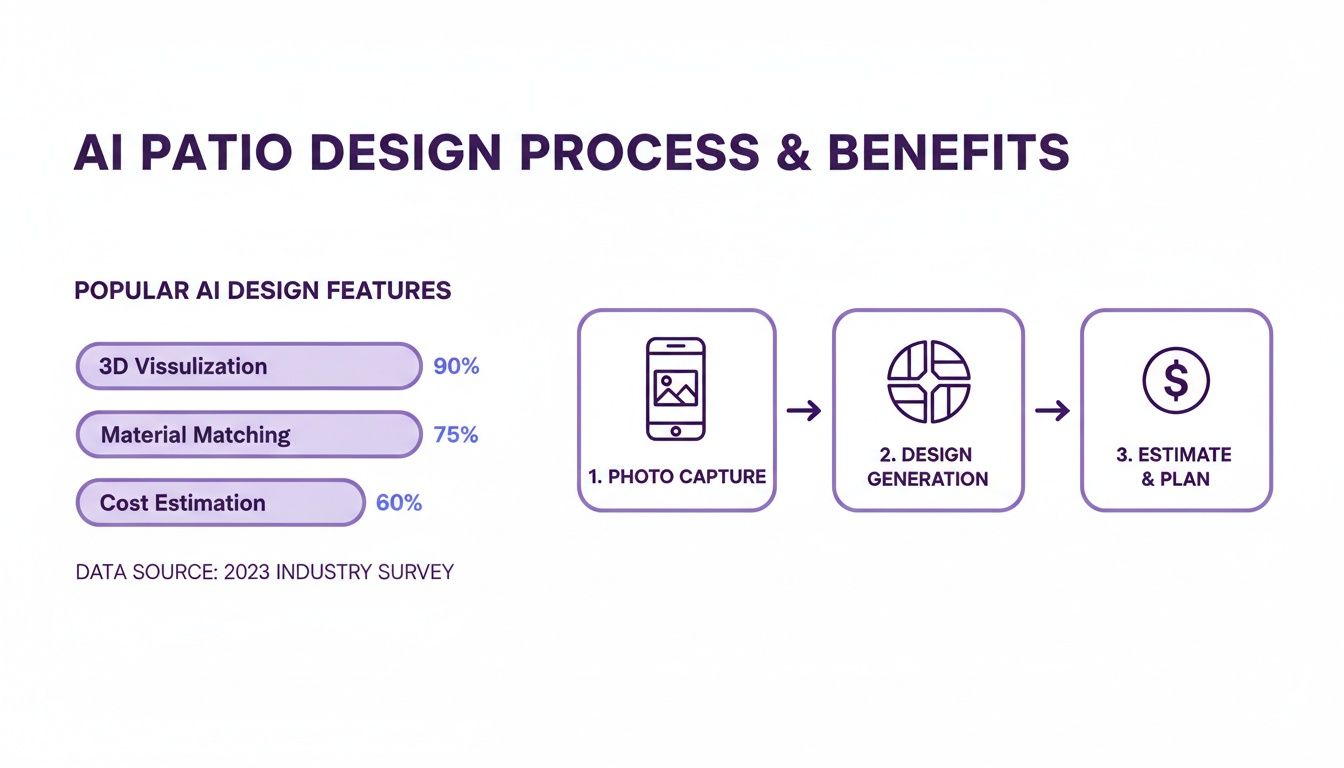
This process lets you snap a photo, play around with different paver designs, and get an instant cost estimate. By seeing exactly how a switch from concrete to flagstone pavers—or from a running bond to a herringbone pattern—impacts both the look and the price, you can find that perfect sweet spot. You can explore some of the free online landscape design tools available and see just how much this tech can help with your planning.
What Your Contractor Quote Really Includes
When a contractor hands you a quote for a new paver patio, it's tempting to jump straight to the bottom line. But that final number is a lot like a bill from a great restaurant—it’s not just the cost of the main course. It includes the appetizer, the drinks, and the skilled service that made the whole experience worthwhile.
To really understand what you're paying for and compare quotes intelligently, you need to look past the total and see the individual components. A professional quote is much more than the price of the pavers; it's a breakdown of all the essential, often invisible, work that guarantees your patio won’t sink, shift, or turn into a puddle after the first big rain.
So, let's pull back the curtain and see what the cost to install a paver patio really covers.
The Foundation: Groundwork and Preparation
Here’s a secret from the pros: the most critical part of any paver project happens before a single paver is even on site. This is where the real work is. Proper site preparation is the bedrock of a long-lasting patio, and it's not unusual for this phase to make up 30–50% of your total project cost.
This isn't just about clearing a space. It involves several key steps:
Excavation and Removal: The crew has to dig. They’ll excavate the entire patio area, typically going down 6 to 12 inches. That means removing tons of grass, soil, or even an old concrete slab.
Grading for Drainage: Your yard isn't perfectly flat, and your patio shouldn't be either. The area is carefully graded with a slight slope—usually about a quarter-inch per foot—to channel rainwater away from your house. This is non-negotiable for protecting your foundation.
Debris Disposal: All that dirt, sod, and old concrete has to go somewhere. The cost of hauling it away and disposing of it properly is always factored into the prep work.
These days, pros are using some seriously cool tech for this. To get a peek into how they map out tricky yards, check out our podcast on using drones for mapping site topography with AI.
The Unsung Hero: Critical Base Layers
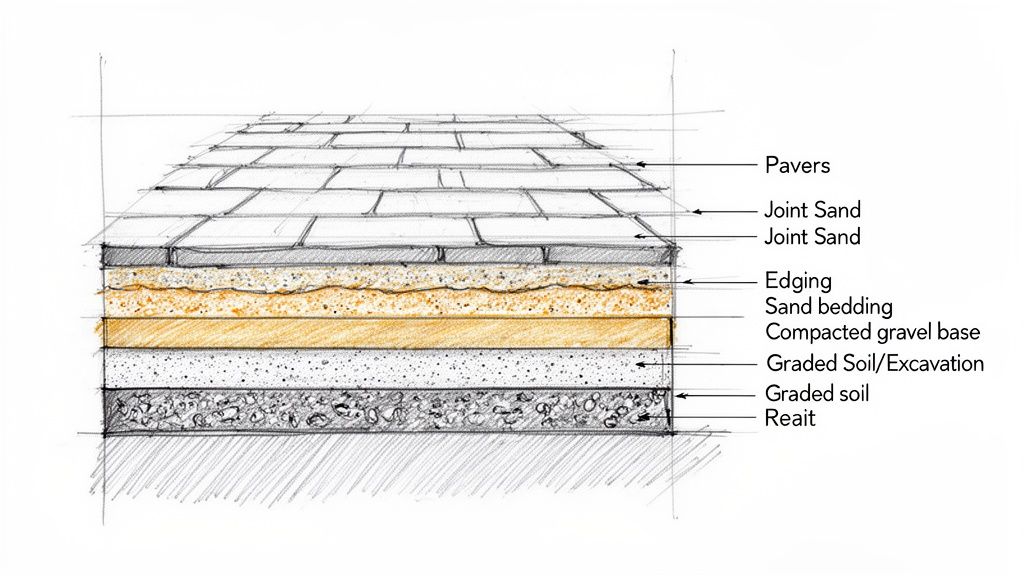
Underneath those beautiful pavers lies a carefully constructed base of gravel and sand. This base is the unsung hero of your patio. It’s what provides the stability to prevent pavers from sinking, shifting, or heaving during freeze-thaw cycles.
Think of the base like the foundation of your house. You never see it, but you know it’s the most important part. A weak foundation means the whole structure will eventually fail. It’s the exact same principle for your patio.
A standard paver base is built in two parts:
A thick layer of compacted crushed rock, called an aggregate base.
A thin, one-inch layer of bedding sand that creates a perfectly level surface for setting the pavers.
The depth of the base matters. A simple walkway might get away with 4-6 inches of base, but a patio needs more support. If you’re building a driveway that needs to hold a car, you could be looking at a base that’s up to 12 inches deep.
The Finishing Touches: Edging, Sand, and Sealing
Once the pavers are all set in their sandy bed, a few final steps lock everything together and protect your investment. These aren't just cosmetic "add-ons"—they're essential for a durable, professional job.
Edging Restraints: These plastic, metal, or concrete borders are installed around the entire perimeter of the patio. Their job is simple but crucial: keep the pavers from spreading apart and creating gaps over time.
Joint Sand: After the pavers are laid, a special type of sand (usually polymeric sand) is swept into all the joints. When you wet it, this sand hardens like a flexible mortar, locking the pavers tight, preventing weeds from sprouting, and keeping ants from moving in.
Sealing (Optional but Highly Recommended): While sometimes listed as an extra, sealing your pavers is a smart move. A good sealant protects them from stains (think spilled wine or grill grease), deepens their color, and makes them way easier to clean. It’s a small investment to keep your patio looking brand new.
Seeing It All Come Together
Reading about base layers and polymeric sand is one thing, but picturing how it will all look in your backyard is another. It can be tough to commit to a design without seeing it first.
This is where you can lean on AI Landscape Design. Before you even talk to a contractor, you can use an app like DreamzAR to snap a photo of your yard and start playing with different paver styles, colors, and patterns. When you can see exactly how a herringbone pattern of bluestone pavers will look next to your house, you can walk into those contractor meetings with confidence. You’ll have a clear vision, making it far easier to get a quote that perfectly matches the patio you’re dreaming of.
DIY Vs. Hiring A Pro: A Realistic Cost Analysis
Deciding whether to build your paver patio yourself or bring in a pro is probably the biggest choice you'll make in this whole process. It's the classic trade-off: save a chunk of cash now, or invest in professional expertise for a smoother ride and guaranteed result. To make the right call, you have to look past the sticker price and get real about what each path truly costs in time, sweat, and risk.
Sure, you can slice the cost to install a paver patio nearly in half by going the DIY route. Labor often makes up a whopping 40-60% of the total project price, so the savings look tempting on paper. But what you save in dollars, you pay for in other ways—your weekends, your back, and the very real risk of making a mistake that costs you more in the long run.
The Realities Of A DIY Installation
Taking on a paver patio installation is an incredibly rewarding project, but let's be clear: it's a beast. This isn't just about laying down some pretty stones. The work is physically brutal and demands a level of precision that can be surprisingly tough to nail on your first try.
Here’s a taste of the real-world challenges you're signing up for:
Heavy Equipment Rental: You can't just eyeball a level base. You'll need to rent a heavy plate compactor to get the foundation solid, and maybe even a sod cutter or small excavator to clear the area. These rentals can easily tack on several hundred dollars to your budget before you've even laid a single paver.
Intense Physical Labor: Prepare yourself for hours upon hours of shoveling, lifting 50-pound pavers, hauling literal tons of gravel and sand, and crawling around on your hands and knees. It's grueling work that can easily consume several weekends, if not more.
The Risk of Costly Mistakes: This is the big one. If you don't grade the base properly, you could end up with water pooling against your house's foundation—a nightmare scenario. If the base isn't compacted evenly, pavers will sink and shift, creating ugly low spots and dangerous tripping hazards. Fixing these kinds of errors can end up costing you more than hiring a pro from the get-go.
The Value Of Hiring A Professional
Yes, hiring a contractor comes with a higher upfront cost, but you're buying a lot more than just a few days of labor. You're investing in experience, efficiency, and most importantly, peace of mind. A professional crew shows up with the specialized tools, the manpower, and the hard-won knowledge to do the job right the first time.
A professional installation is really an insurance policy on your investment. Their expertise ensures the base prep and drainage are flawless—the two things that make or break a patio's lifespan—and a warranty gives you a safety net if anything goes wrong down the road.
Here’s the value a pro brings to the table:
Expertise and Efficiency: What might take you several long weekends, an experienced crew can knock out in just a few days. They've seen it all and know exactly how to handle curveballs like tricky soil conditions or intricate herringbone patterns without missing a beat.
Proper Tools and Materials: Pros have commercial-grade equipment and access to high-quality materials, ensuring every layer of your patio, from the sub-base to the final paver, is built to industry standards.
Warranty and Accountability: A reputable contractor will stand by their work. If your patio settles or has any issues within the warranty period, they’ll come back and fix it. That's a guarantee you just don't get when you're the one holding the shovel.
Before you make the final call, it’s a huge help to see exactly what you’re trying to build. You can apply AI Landscape Design to visualize your ideas using photos of your own yard. A tool like an AI landscape designer lets you create a detailed plan, and when you can see the finished design and get a rough cost estimate, you're in a much better position to have a smart conversation with contractors or build a precise shopping list for your DIY project.
Smart Ways To Save On Your Paver Patio
A stunning paver patio doesn't have to come with a shocking price tag. If you make a few strategic choices, you can dramatically lower the total installation cost without cutting corners on quality or style. It’s really just about working smarter to get the outdoor space you’ve always wanted.
The key is to look at the two biggest line items on any quote—materials and labor—and find clever ways to trim them down. A few thoughtful adjustments can easily free up hundreds, or even thousands, of dollars, making that dream patio much more attainable than you might think.
Choose Your Materials Wisely
The type of paver you fall in love with is one of the biggest factors in your final bill. While high-end natural stone is undeniably beautiful, it can also double or even triple your material costs.
Opt for Concrete Pavers: Don't sleep on modern concrete pavers. They are a fantastic, budget-friendly alternative and come in a huge range of colors, shapes, and textures that do a surprisingly good job of mimicking expensive natural stone. You get that high-end feel for a fraction of the price.
Keep the Design Simple: Complex patterns like herringbone or basketweave look amazing, but they require way more cuts and precision from the installation crew. That means more labor hours. Sticking to a classic, straightforward running bond pattern is one of the easiest ways to keep installation time—and your labor bill—in check.
Get Smart With Your Timing and Labor
Beyond the materials themselves, how and when you decide to build can unlock some major savings. A little flexibility and a bit of sweat equity can go a long, long way.
Here's a great hybrid approach: handle the grunt work yourself. If you can tackle the non-technical tasks like tearing out an old concrete slab or clearing and leveling the area, you can shave a significant amount off the pros' billable hours. Let them handle the critical base preparation and paver laying.
Another pro tip is to schedule your project during the off-season. Landscaping contractors are slammed in the spring and summer. If you can wait until the fall or even early winter, you might find they’re willing to offer more competitive rates just to keep their crews busy.
Visualize Your Budget Before You Build
Honestly, one of the biggest money-saving tools is one you can use before a single shovel hits the dirt. Planning your project by applying AI Landscape Design to visualize your ideas using photos of your own yard helps you sidestep expensive mistakes and budget overruns right from the get-go.
With an app like DreamzAR, you just upload a photo and start experimenting. You can play with different patio sizes, materials, and layouts in real-time. See exactly how a 200-square-foot patio looks versus a 300-square-foot one in your actual space. This simple step helps you lock in the perfect size that fits your needs without overbuilding and overspending.
By seeing how different paver styles look on your home, you can confidently pick a cost-effective option that still gives you the exact look you're going for. This digital-first approach ensures every dollar you spend has a purpose, helping you design a beautiful patio that fits your vision and your budget perfectly.
Common Questions About Paver Patio Costs
Even with a detailed budget in hand, a few questions about the bigger picture are bound to pop up. Let's tackle some of the most common ones we hear from homeowners, so you can move forward with total confidence.
Does a Paver Patio Increase Home Value?
Absolutely. A thoughtfully designed and professionally installed paver patio is a fantastic investment. Homeowners often see a return of 50% to 80% of the cost when they sell their home.
It does more than just add square footage; it enhances your home's curb appeal and creates a functional, inviting outdoor living area. For potential buyers, that kind of space isn't just a bonus—it's a major selling point that can make your property stand out. Think of it as an investment in your lifestyle now, and your property's value later.
How Long Does Paver Patio Installation Take?
This really boils down to the project's size and complexity.
Hiring a Pro: For an average-sized patio (around 200-400 sq. ft.), a professional crew can usually get the job done in 2 to 5 days. That timeframe covers everything from excavation and base prep to laying the last paver.
Doing It Yourself: If you're going the DIY route, be prepared for it to be a multi-weekend project. How long it takes will depend on your skill level, the tools you have on hand, and whether the weather decides to cooperate.
Are Permeable Pavers More Expensive to Install?
Yes, they usually are. The upfront cost for a permeable paver patio is higher, typically falling in the $20 to $50 per square foot range.
The extra cost isn't in the pavers themselves but in the extensive prep work underneath. A permeable system needs a much deeper, multi-layered gravel base designed to let water drain right through. This means more digging, more specialized base materials, and more labor to get it right.
While the initial hit to the wallet is bigger, permeable pavers can save you money down the road. They often eliminate the need for other costly drainage solutions and are a huge help in managing stormwater runoff—a major plus in many areas.
Can I See What My Patio Will Look Like Before I Pay for It?
Yes, and you definitely should! One of the best ways to feel good about your budget is to see exactly what you're getting for your money. This is where AI Landscape Design tools can be a game-changer.
Apps like DreamzAR let you use a photo of your own yard to experiment with different paver styles, patterns, and colors right on your phone. It’s a fantastic way to balance the look you want with the price you can afford, ensuring you’ll love the final result before anyone even breaks ground.
Ready to stop guessing and start visualizing? With DreamzAR, you can see your perfect paver patio in your own yard in seconds. Download the #1 AI Landscape Design App today and bring your dream outdoor space to life. Your ideal yard is just one photo away. Visit https://www.dreamzar.app to get started for free.